Question:
Real size
Writing - Request Email
Zoom out
Drag the red vertical line to resize the question/typing area.
Press Shift+Left/Right arrow keys to select text, "Tab" key to insert TAB character.
- Media Management
How companies could respond to charges their products are dangerous
Tylenol is the latest product to be in the public spotlight because of allegations that a well-known product or one of its
ingredients are dangerous or harmful in some way. Yesterday, President Donald Trump "endorsed unsubstantiated claims
about a link between Tylenol and autism... offering perhaps his most emphatic support to date of Health Secretary
Robert F. Kennedy Jr.'s agenda,"
"Don't take Tylenol. Don't take it. Fight like hell not to take it," Trump said at a White House briefing. But according to
a wide variety of experts around the world, "there was not conclusive evidence to support the possible association
between autism and acetaminophen-the active ingredient in Tylenol and other widely used medications and no new
evidence to warrant a change in guidance," the news organization said.
A spokesperson for Kenvue, which manufactures Tylenol, said in a statement last night that "we believe independent,
sound science clearly shows that taking acetaminophen does not cause autism,"
There are several things that companies can do when they are under the harsh glare of the public spotlight because of
charges that what they make are harmful and unsafe. Sometimes the allegations can be made by government agencies,
such as the Consumer Product Safety Commission. There have been several headline-making product recalls, including
Peloton, which recalled two million exercise bikes due to fall and injury hazards; Stellantis, which makes Jeep Cherokee,
recalled 132,000 vehicles because of the risk of fire; and Gerber, which recalled some of its baby formula.
Before doing or saying anything about the allegations, it is important to first conduct a reality check about the charges.
""The first step I'd recommend is assessing the spread of the information-understanding how far it has travelled and the
legitimacy of the individuals or sources amplifying it. Then you can develop a strategy to respond," Vishakha Mathur,
vice president at SKDK, a strategic communications company, told me in an email message.
One of the steps in implementing a response strategy "would be to acknowledge the concern and commit to transparency,
even if there is nothing to back-up the allegations. The public needs to see that you take their safety seriously. Express
empathy for anyone who may feel harmed, while making it clear you are investigating. It's not about admitting guilt-
it's about showing responsibility," Tom Letizia, a crisis management expert, told me in an email interview.
The longer companies stay quiet about the allegations, the more likely it is that the charges will become conventional
wisdom and assumed to be true, and run the risk of losing control of the narrative about the crisis. "It is better in these
situations to not go silent, but have company responses be carefully considered and addressed by the CEO or product
lead only, not by engaging in arguments in the press or on social media. In short - be the source of wisdom and calm
remedy, not the cause of the stress," Cheryl Conner, CEO of SnappConner PR, said.
As
with any crisis, it can be dangerous to wait until executives feel comfortable about discussing the situation.
Umove quickly, but you also have to move carefully. If you stay silent, someone else defines your story. If
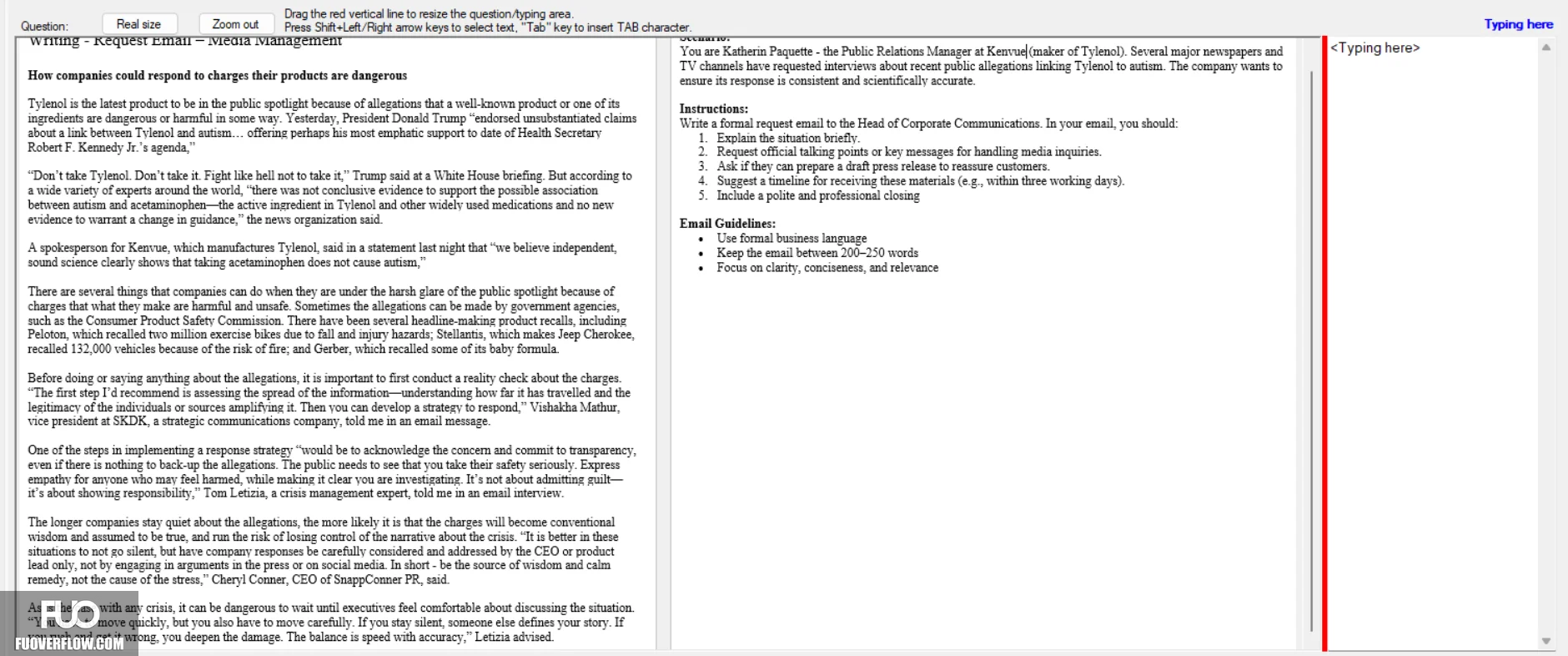
You are Katherin Paquette - the Public Relations Manager at Kenvuel (maker of Tylenol). Several major newspapers and
TV channels have requested interviews about recent public allegations linking Tylenol to autism. The company wants to
ensure its response is consistent and scientifically accurate.
Instructions:
Write a formal request email to the Head of Corporate Communications. In your email, you should:
1. Explain the situation briefly.
2. Request official talking points or key messages for handling media inquiries.
3. Ask if they can prepare a draft press release to reassure customers.
4. Suggest a timeline for receiving these materials (e.g., within three working days).
5. Include a polite and professional closing
Email Guidelines:
Use formal business language
Keep the email between 200-250 words
Focus on clarity, conciseness, and relevance
Typing here
<Typing here>