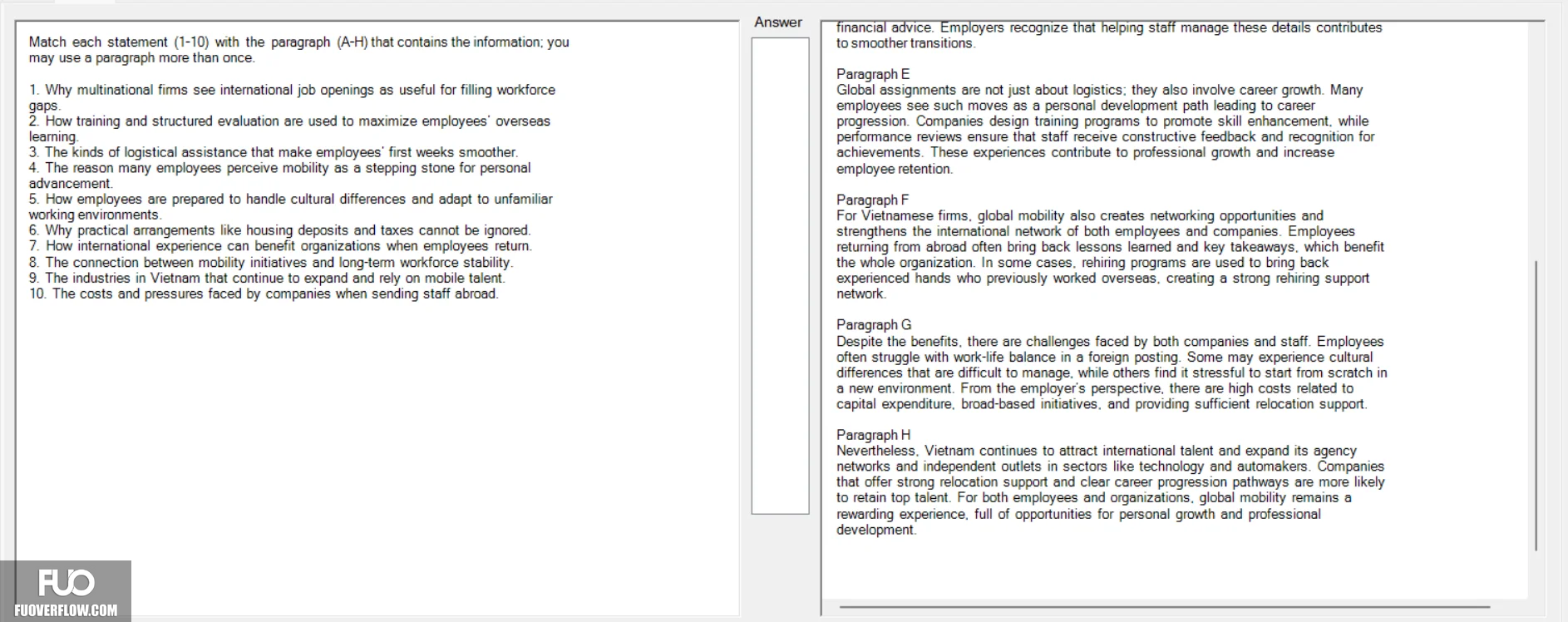
Match each statement (1-10) with the paragraph (A-H) that contains the information; you
may use a paragraph more than once.
1. Why multinational firms see international job openings as useful for filling workforce
gaps.
2. How training and structured evaluation are used to maximize employees' overseas
learning
3. The kinds of logistical assistance that make employees' first weeks smoother.
4. The reason many employees perceive mobility as a stepping stone for personal
advancement.
5. How employees are prepared to handle cultural differences and adapt to unfamiliar
working environments.
6. Why practical arrangements like housing deposits and taxes cannot be ignored.
7. How international experience can benefit organizations when employees return.
8. The connection between mobility initiatives and long-term workforce stability.
9. The industries in Vietnam that continue to expand and rely on mobile talent.
10. The costs and pressures faced by companies when sending staff abroad.
financial advice. Employers recognize that helping staff manage these details contributes
to smoother transitions.
Paragraph E
Global assignments are not just about logistics; they also involve career growth. Many
employees see such moves as a personal development path leading to career
progression. Companies design training programs to promote skill enhancement, while
performance reviews ensure that staff receive constructive feedback and recognition for
achievements. These experiences contribute to professional growth and increase
employee retention.
Paragraph F
For Vietnamese firms, global mobility also creates networking opportunities and
strengthens the international network of both employees and companies. Employees
returning from abroad often bring back lessons learned and key takeaways, which benefit
the whole organization. In some cases, rehiring programs are used to bring back
experienced hands who previously worked overseas, creating a strong rehiring support
network.
Paragraph G
Despite the benefits, there are challenges faced by both companies and staff. Employees
often struggle with work-life balance in a foreign posting. Some may experience cultural
differences that are difficult to manage, while others find it stressful to start from scratch in
a new environment. From the employer's perspective, there are high costs related to
capital expenditure, broad-based initiatives, and providing sufficient relocation support.
Paragraph H
Nevertheless. Vietnam continues to attract international talent and expand its agency
networks and independent outlets in sectors like technology and automakers. Companies
that offer strong relocation support and clear career progression pathways are more likely
to retain top talent. For both employees and organizations, global mobility remains a
rewarding experience, full of opportunities for personal growth and professional
development.