(Choose 2 answers)
A. (II)
B. (1)
C. (IV)
D. (III)
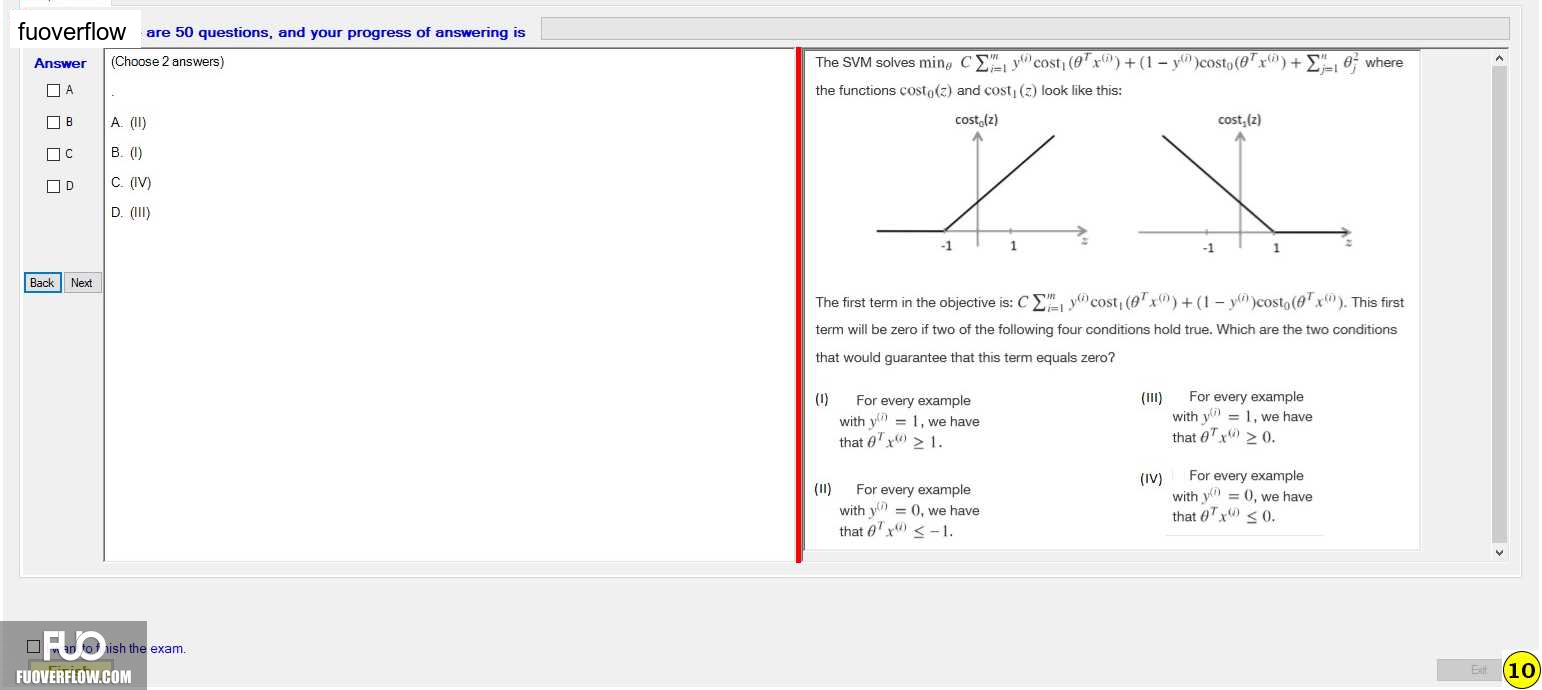
The SVM solves ming Cycost ( x^{(i)})+(1-y^{(i)} ) costo(0) + \sum_{i=1}^{n}\theta_{i}^{2} where the functions costo(z) and cost, (z) look like this:
cost(z)
cost, (z)
-1
1
-1
1
The first term in the objective is: C\sum_{i=1}^{m}y^{(i)}cost_{1}(\theta^{T}x^{(i)})+(1-y^{(i)})cost_{0}(\theta^{T}x^{(i)}). This first term will be zero if two of the following four conditions hold true. Which are the two conditions that would guarantee that this term equals zero?
(1)For every example h~v^{(i)}=1.we have that \theta^{T}x^{(0)}\ge1
(Ⅲ)For every example with h~y^{(\prime)}=1,w\epsilon have that \theta^{T}x^{(i)}\ge0.
(IV)For every example h_{n}(i)-0~cos~hi with that \theta^{T}x^{(i)}\le0
(II)For every example with v^{(\overline{i})}=0. we have that x-1.
El 10