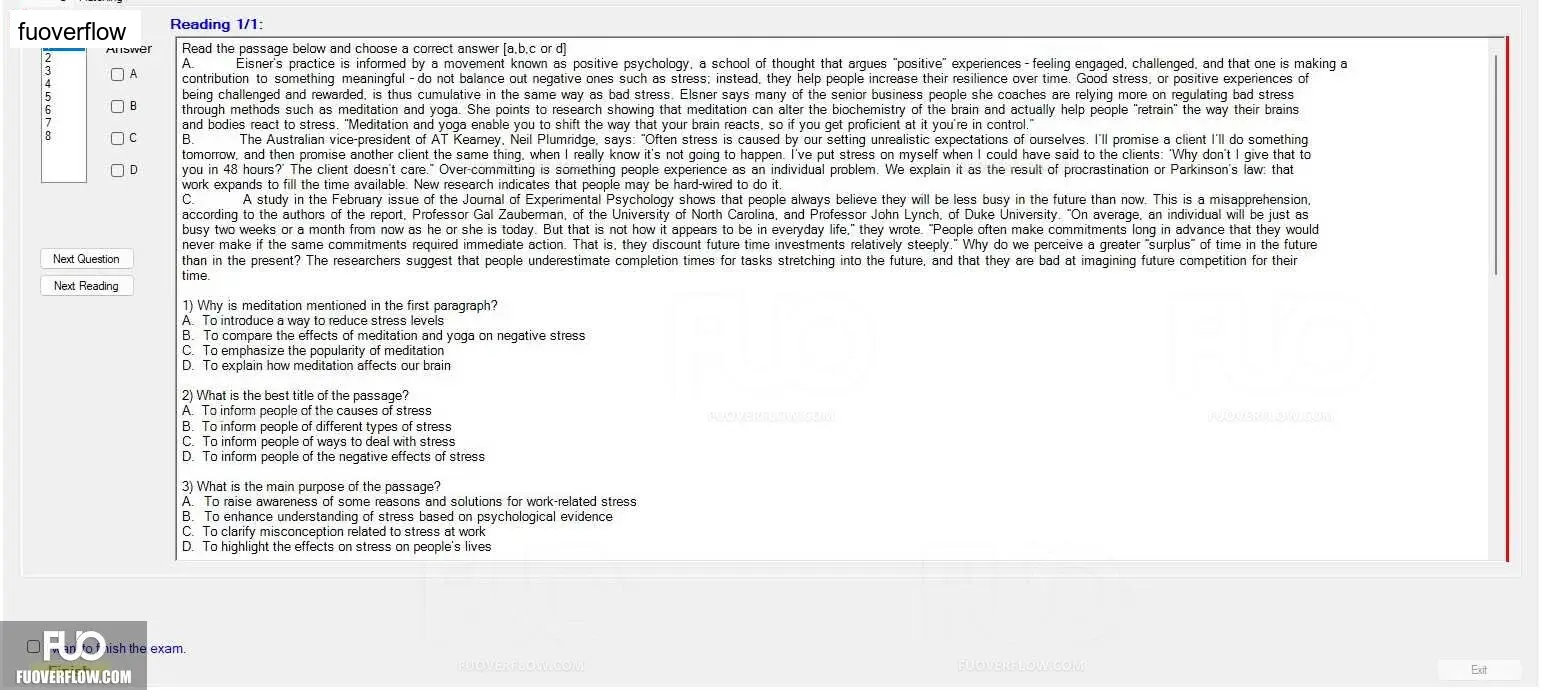
Reading 1/1:
Read the passage below and choose a correct answer [a,b,c or d]
2345678
A.Eisner's practice is informed by a movement known as positive psychology, a school of thought that argues "positive" experiences - feeling engaged, challenged, and that one is making a contribution to something meaningful - do not balance out negative ones such as stress; instead, they help people increase their resilience over time. Good stress, or positive experiences of being challenged and rewarded, is thus cumulative in the same way as bad stress. Elsner says many of the senior business people she coaches are relying more on regulating bad stress through methods such as meditation and yoga. She points to research showing that meditation can alter the biochemistry of the brain and actually help people "retrain" the way their brains and bodies react to stress. "Meditation and yoga enable you to shift the way that your brain reacts, so if you get proficient at it you're in control."B. The Australian vice-president of AT Kearney. Neil Plumridge, says: "Often stress is caused by our setting unrealistic expectations of ourselves. I'll promise a client I'll do something
tomorrow, and then promise another client the same thing, when I really know it's not going to happen. I've put stress on myself when I could have said to the clients: 'Why don't I give that to
you in 48 hours? The client doesn't care." Over-committing is something people experience as an individual problem. We explain it as the result of procrastination or Parkinson's law: that
work expands to fill the time available. New research indicates that people may be hard-wired to do it.C.A study in the February issue of the Journal of Experimental Psychology shows that people always believe they will be less busy in the future than now. This is a misapprehension,according to the authors of the report. Professor Gal Zauberman, of the University of North Carolina, and Professor John Lynch, of Duke University. "On average, an individual will be just as busy two weeks or a month from now as he or she is today. But that is not how it appears to be in everyday life," they wrote. "People often make commitments long in advance that they would never make if the same commitments required immediate action. That is, they discount future time investments relatively steeply." Why do we perceive a greater "surplus" of time in the future than in the present? The researchers suggest that people underestimate completion times for tasks stretching into the future, and that they are bad at imagining future competition for their
time.
Next Question
Next Reading
1) Why is meditation mentioned in the first paragraph?A. To introduce a way to reduce stress levels
To compare the effects of meditation and yoga on negative stress
C. To emphasize the popularity of meditation D. To explain how meditation affects our brain
2) What is the best title of the passage?A. To inform people of the causes of stress
B.
To inform people of different types of stress . To inform people of ways to deal with stress
C D. To inform people of the negative effects of stress
) What is the main purpose of the passage?
3 To raise awareness of some reasons and solutions for work-related stress psychological evidence
ABCD To highlight the effects on stress on people's lives
To enhance understanding of stress based on To clarify misconception related to stress at work