Install the app
How to install the app on iOS
Follow along with the video below to see how to install our site as a web app on your home screen.
Note: This feature may not be available in some browsers.
-

Cùng tham gia nhóm của FuOverflow trên Facebook https://www.facebook.com/groups/nvh2fuoverflow
You are using an out of date browser. It may not display this or other websites correctly.
You should upgrade or use an alternative browser.
You should upgrade or use an alternative browser.
V
ENT403_-_SP_2024_-_R_-_RE_1438.webp
Bài viết gốc: Chủ đề 'ENT403 - SP 2024 - R - RE'
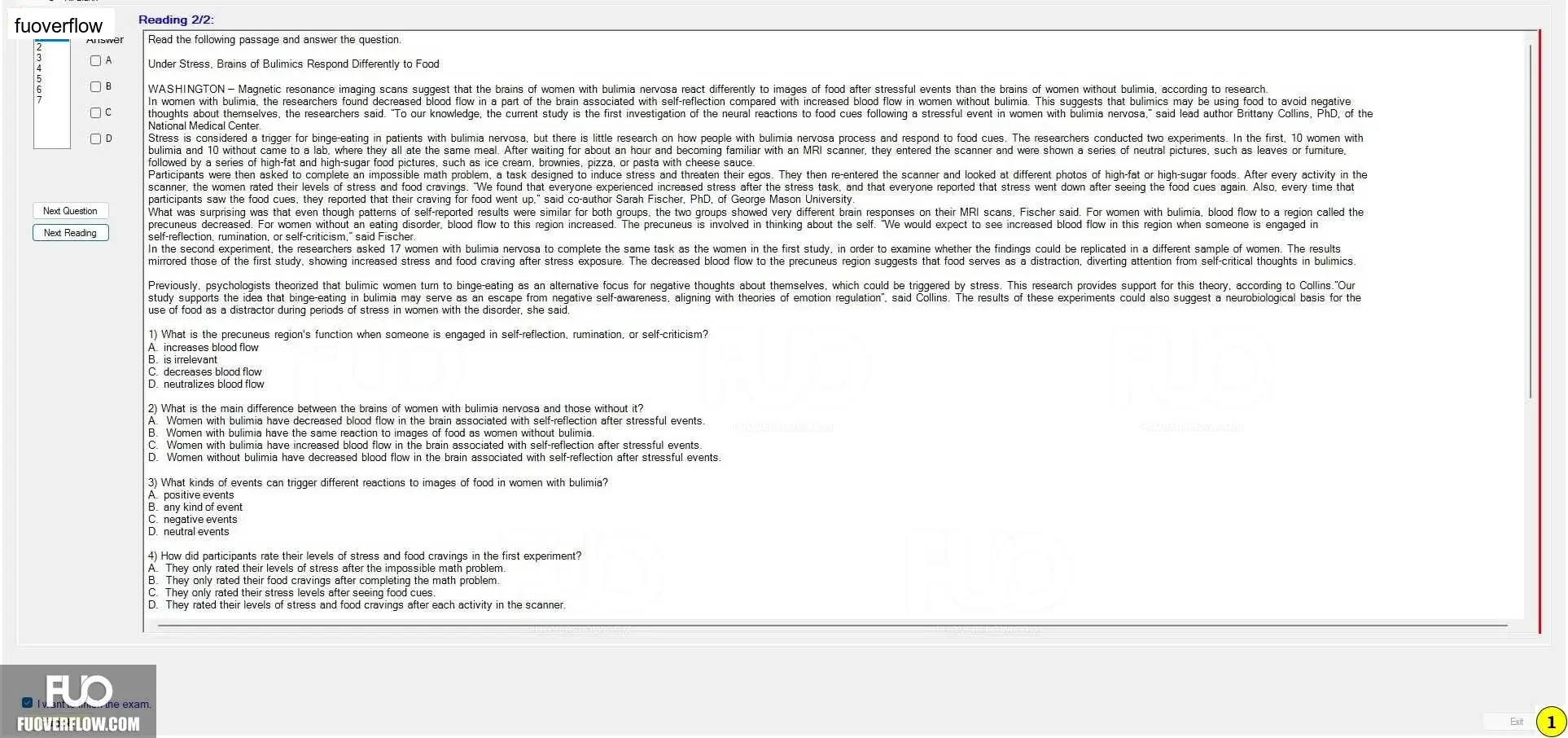
Reading 2/2:
Read the following passage and answer the question.
Under Stress, Brains of Bulimics Respond Differently to Food
WASHINGTON- Magnetic resonance imaging scans suggest that the brains of women with bulimia nervosa react differently to images of food after stressful events than the brains of women without bulimia, according to research.
In women with bulimia, the researchers found decreased blood flow in a part of the brain associated with self-reflection compared with increased blood flow in women without bulimia. This suggests that bulimics may be using food to avoid negative
thoughts about themselves, the researchers said. "To our knowledge, the current study is the first investigation of the neural reactions to food cues following a stressful event in women with bulimia nervosa," said lead author Brittany Collins, PhD, of the National Medical Center.Stress is considered a trigger for binge-eating in patients with bulimia nervosa, but there is little research on how people with bulimia nervosa process and respond to food cues. The researchers conducted two experiments. In the first, 10 women with
bulimia and 10 without came to a lab, where they all ate the same meal. After waiting for about an hour and becoming familiar with an MRI scanner, they entered the scanner and were shown a series of neutral pictures, such as leaves or furniture.followed by a series of high-fat and high-sugar food pictures, such as ice cream, brownies, pizza, or pasta with cheese sauce.Participants were then asked to complete an impossible math problem, a task designed to induce stress and threaten their egos. They then re-entered the scanner and looked at different photos of high-fat or high-sugar foods. After every activity in the
scanner, the women rated their levels of stress and food cravings. "We found that everyone experienced increased stress after the stress task, and that everyone reported that stress went down after seeing the food cues again. Also, every time that participants saw the food cues, they reported that their craving for food went up." said co-author Sarah Fischer, PhD, of George Mason University.What was surprising was that even though patterns of self-reported results were similar for both groups, the two groups showed very different brain responses on their MRI scans, Fischer said. For women with bulimia, blood flow to a region called the
precuneus decreased. For women without an eating disorder, blood flow to this region increased. The precuneus is involved in thinking about the self. "We would expect to see increased blood flow in this region when someone is engaged in
Next Question
Next Reading
1
self-reflection, rumination, or self-criticism," said Fischer.In the second experiment, the researchers asked 17 women with bulimia nervosa to complete the same task as the women in the first study, in order to examine whether the findings could be replicated in a different sample of women. The results mirrored those of the first study, showing increased stress and food craving after stress exposure. The decreased blood flow to the precuneus region suggests that food serves as a distraction, diverting attention from self-critical thoughts in bulimics.Previously, psychologists theorized that bulimic women turn to binge-eating as an alternative focus for negative thoughts about themselves, which could be triggered by stress. This research provides support for this theory, according to Collins. "Ourstudy supports the idea that binge-eating in bulimia may serve as an escape from negative self-awareness, aligning with theories of emotion regulation", said Collins. The results of these experiments could also suggest a neurobiological basis for the
use of food as a distractor during periods of stress in women with the disorder, she said.
1)A. increases blood flow
ABCD
What is the precuneus region's function when someone is engaged in self-reflection, rumination, or self-criticism?
is irrelevant
decreases blood flow D. neutralizes blood flow
2) What is the main difference between the brains of women with bulimia nervosa and those without it?withbulimia have decreased blood flow in the brain associated with self-reflection after stressful events.
ABCD
Women Women with bulimia have the same reaction to images of food as women without bulimia.
Women with bulimia have increased blood flow in the brain associated with self-reflection after stressful events.Women without bulimia have decreased blood flow in the brain associated with self-reflection after stressful events.
3)positive events
ABCD
What kinds of events can trigger different reactions to images of food in women with bulimia?
any kind of event
negative events neutral events
4) How did participants rate their levels of stress and food cravings in the first experiment?They only rated their levels of stress after the impossible math problem.
FABCD D. They rated their levels of stress and food cravings after each activity in the scanner.
They only rated their food cravings after completing the math problem.They only rated their stress levels after seeing food cues.
234567
Read the following passage and answer the question.
Under Stress, Brains of Bulimics Respond Differently to Food
WASHINGTON- Magnetic resonance imaging scans suggest that the brains of women with bulimia nervosa react differently to images of food after stressful events than the brains of women without bulimia, according to research.
In women with bulimia, the researchers found decreased blood flow in a part of the brain associated with self-reflection compared with increased blood flow in women without bulimia. This suggests that bulimics may be using food to avoid negative
thoughts about themselves, the researchers said. "To our knowledge, the current study is the first investigation of the neural reactions to food cues following a stressful event in women with bulimia nervosa," said lead author Brittany Collins, PhD, of the National Medical Center.Stress is considered a trigger for binge-eating in patients with bulimia nervosa, but there is little research on how people with bulimia nervosa process and respond to food cues. The researchers conducted two experiments. In the first, 10 women with
bulimia and 10 without came to a lab, where they all ate the same meal. After waiting for about an hour and becoming familiar with an MRI scanner, they entered the scanner and were shown a series of neutral pictures, such as leaves or furniture.followed by a series of high-fat and high-sugar food pictures, such as ice cream, brownies, pizza, or pasta with cheese sauce.Participants were then asked to complete an impossible math problem, a task designed to induce stress and threaten their egos. They then re-entered the scanner and looked at different photos of high-fat or high-sugar foods. After every activity in the
scanner, the women rated their levels of stress and food cravings. "We found that everyone experienced increased stress after the stress task, and that everyone reported that stress went down after seeing the food cues again. Also, every time that participants saw the food cues, they reported that their craving for food went up." said co-author Sarah Fischer, PhD, of George Mason University.What was surprising was that even though patterns of self-reported results were similar for both groups, the two groups showed very different brain responses on their MRI scans, Fischer said. For women with bulimia, blood flow to a region called the
precuneus decreased. For women without an eating disorder, blood flow to this region increased. The precuneus is involved in thinking about the self. "We would expect to see increased blood flow in this region when someone is engaged in
Next Question
Next Reading
1
self-reflection, rumination, or self-criticism," said Fischer.In the second experiment, the researchers asked 17 women with bulimia nervosa to complete the same task as the women in the first study, in order to examine whether the findings could be replicated in a different sample of women. The results mirrored those of the first study, showing increased stress and food craving after stress exposure. The decreased blood flow to the precuneus region suggests that food serves as a distraction, diverting attention from self-critical thoughts in bulimics.Previously, psychologists theorized that bulimic women turn to binge-eating as an alternative focus for negative thoughts about themselves, which could be triggered by stress. This research provides support for this theory, according to Collins. "Ourstudy supports the idea that binge-eating in bulimia may serve as an escape from negative self-awareness, aligning with theories of emotion regulation", said Collins. The results of these experiments could also suggest a neurobiological basis for the
use of food as a distractor during periods of stress in women with the disorder, she said.
1)A. increases blood flow
ABCD
What is the precuneus region's function when someone is engaged in self-reflection, rumination, or self-criticism?
is irrelevant
decreases blood flow D. neutralizes blood flow
2) What is the main difference between the brains of women with bulimia nervosa and those without it?withbulimia have decreased blood flow in the brain associated with self-reflection after stressful events.
ABCD
Women Women with bulimia have the same reaction to images of food as women without bulimia.
Women with bulimia have increased blood flow in the brain associated with self-reflection after stressful events.Women without bulimia have decreased blood flow in the brain associated with self-reflection after stressful events.
3)positive events
ABCD
What kinds of events can trigger different reactions to images of food in women with bulimia?
any kind of event
negative events neutral events
4) How did participants rate their levels of stress and food cravings in the first experiment?They only rated their levels of stress after the impossible math problem.
FABCD D. They rated their levels of stress and food cravings after each activity in the scanner.
They only rated their food cravings after completing the math problem.They only rated their stress levels after seeing food cues.
234567
Thông tin
- Category
- ENT403
- Thêm bởi
- vanthang97
- Ngày thêm
- Lượt xem
- 690
- Lượt bình luận
- 0
- Rating
- 0.00 star(s) 0 đánh giá
Image metadata
- Filename
- ENT403_-_SP_2024_-_R_-_RE_1438.webp
- File size
- 209.3 KB
- Dimensions
- 1926px x 906px