Reading
Questions
OD
12345678910
Reading 2/2:
Read the following passage and choose the correct answer for each question.
Disinformation wars: The fight against fake news in the age of Al
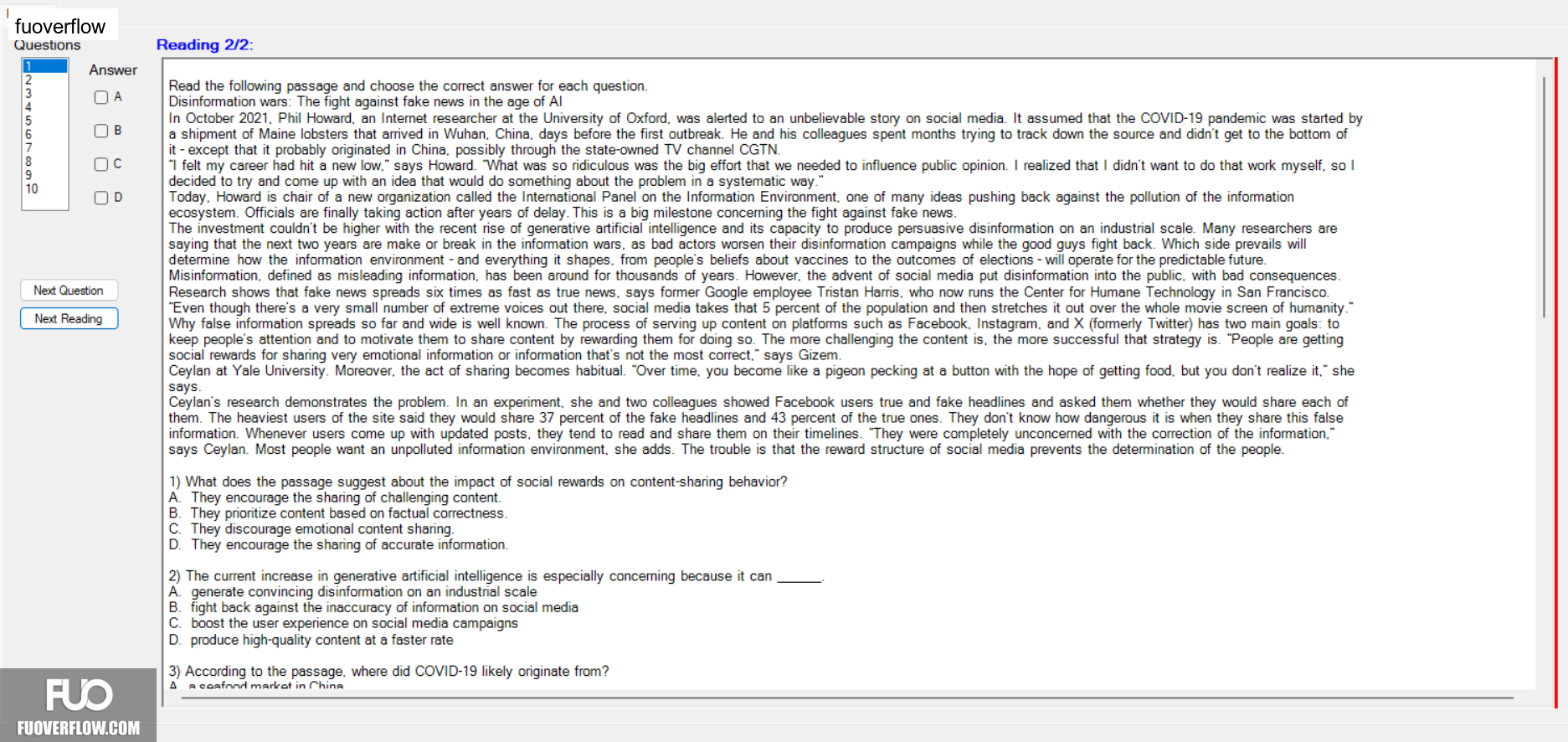
In October 2021, Phil Howard, an Internet researcher at the University of Oxford, was alerted to an unbelievable story on social media. It assumed that the COVID-19 pandemic was started by
a shipment of Maine lobsters that arrived in Wuhan, China, days before the first outbreak. He and his colleagues spent months trying to track down the source and didn't get to the bottom of it-except that it probably originated in China, possibly through the state-owned TV channel CGTN."I felt my career had hit a new low," says Howard. "What was so ridiculous was the big effort that we needed to influence public opinion. I realized that I didn't want to do that work myself, so I
decided to try and come up with an idea that would do something about the problem in a systematic way.Today. Howard is chair of a new organization called the International Panel on the Information Environment, one of many ideas pushing back against the pollution of the information . This is a big milestone concerning the fight against fake news.
ecosystem. Officials are finally taking action after years of delay The investment couldn't be higher with the recent rise of generative artificial intelligence and its capacity to produce persuasive disinformation on an industrial scale. Many researchers are
saying that the next two years are make or break in the information wars, as bad actors worsen their disinformation campaigns while the good guys fight back. Which side prevails will people's beliefs about vaccines to the outcomes of elections - will operate for the predictable future.
Next Question
determine how the information environment and everything it shapes, from Misinformation, defined as misleading information, has been around for thousands of years. However, the advent of social media put disinformation into the public, with bad consequences.Research shows that fake news spreads six times as fast as true news, says former Google employee Tristan Harris, who now runs the Center for Humane Technology in San Francisco."Even though there's a very small number of extreme voices out there, social media takes that 5 percent of the population and then stretches it out over the whole movie screen of humanity."
Next Reading
Why false information spreads so far and wide is well known. The process of serving up content on platforms such as Facebook, Instagram, and X (formerly Twitter) has two main goals: to keep people's attention and to motivate them to share content by rewarding them for doing so. The more challenging the content is, the more successful that strategy is. "People are getting social rewards for sharing very emotional information or information that's not the most correct," says Gizem.Ceylan at Yale University. Moreover, the act of sharing becomes habitual. "Over time, you become like a pigeon pecking at a button with the hope of getting food, but you don't realize it," she
says.
Ceylan's research demonstrates the problem. In an experiment, she and two colleagues showed Facebook users true and fake headlines and asked them whether they would share each of them. The heaviest users of the site said they would share 37 percent of the fake headlines and 43 percent of the true ones. They don't know how dangerous it is when they share this false information. Whenever users come up with updated posts, they tend to read and share them on their timelines. "They were completely unconcerned with the correction of the information."
says Ceylan. Most people want an unpolluted information environment, she adds. The trouble is that the reward structure of social media prevents the determination of the people.
1) What does the passage suggest about the impact of social rewards on content-sharing behavior?
A. They encourage the sharing of challenging content.B. They prioritize content based on factual correctness.
C. They discourage emotional content sharing.D. They encourage the sharing of accurate information.
) The current increase in generative artificial intelligence is especially concerning because it can 2
. generate convincing disinformation on an industrial scale A
B. fight back against the inaccuracy of information on social media
C. boost the user experience on social media campaigns D. produce high-quality content at a faster rate
3) According to the passage, where did COVID-19 likely originate from?A a coafood market in China