Install the app
How to install the app on iOS
Follow along with the video below to see how to install our site as a web app on your home screen.
Note: This feature may not be available in some browsers.
-

Cùng tham gia nhóm của FuOverflow trên Facebook https://www.facebook.com/groups/nvh2fuoverflow
You are using an out of date browser. It may not display this or other websites correctly.
You should upgrade or use an alternative browser.
You should upgrade or use an alternative browser.
Bài viết gốc: Chủ đề 'ENW492c - C1 - RFESP24'
Questions
2345
Reading 1/1:
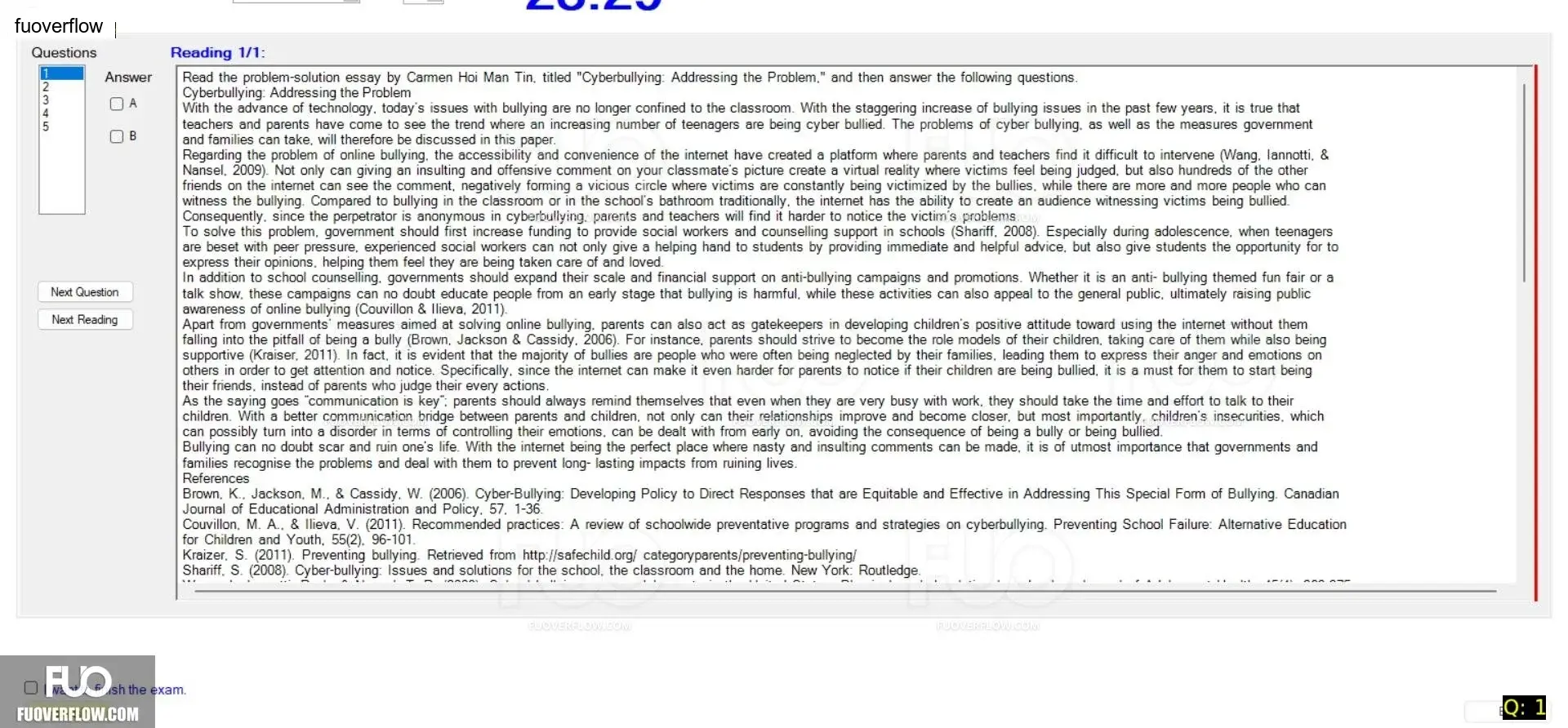
Read the problem-solution essay by Carmen Hoi Man Tin, titled "Cyberbullying: Addressing the Problem," and then answer the following questions.Cyberbullying: Addressing the Problem
With the advance of technology, today's issues with bullying are no longer confined to the classroom. With the staggering increase of bullying issues in the past few years, it is true that teachers and parents have come to see the trend where an increasing number of teenagers are being cyber bullied. The problems of cyber bullying, as well as the measures government and families can take, will therefore be discussed in this paper.
Regarding the problem of online bullying, the accessibility and convenience of the internet have created a platform where parents and teachers find it difficult to intervene (Wang, lannotti, &
Nansel, 2009). Not only can giving an insulting and offensive comment on your classmate's picture create a virtual reality where victims feel being judged, but also hundreds of the other
friends on the internet can see the comment, negatively forming a vicious circle where victims are constantly being victimized by the bullies, while there are more and more people who can
witness the bullying. Compared to bullying in the classroom or in the school's bathroom traditionally, the internet has the ability to create an audience witnessing victims being bullied.
Consequently, since the perpetrator is anonymous in cyberbullying, parents and teachers will find it harder to notice the victim's problems.
To solve this problem, government should first increase funding to provide social workers and counselling support in schools (Shariff, 2008). Especially during adolescence, when teenagers are beset with peer pressure, experienced social workers can not only give a helping hand to students by providing immediate and helpful advice, but also give students the opportunity for to express their opinions, helping them feel they are being taken care of and loved.In addition to school counselling, governments should expand their scale and financial support on anti-bullying campaigns and promotions. Whether it is an anti- bullying themed fun fair or a
Next Question
talk show, these campaigns can no doubt educate people from an early stage that bullying is harmful, while these activities can also appeal to the general public, ultimately raising public awareness of online bullying (Couvillon & Ilieva, 2011).
Next Reading
Apart from governments' measures aimed at solving online bullying, parents can also act as gatekeepers in developing children's positive attitude toward using the internet without them falling into the pitfall of being a bully (Brown, Jackson & Cassidy, 2006). For instance, parents should strive to become the role models of their children, taking care of them while also being supportive (Kraiser, 2011). In fact, it is evident that the majority of bullies are people who were often being neglected by their families, leading them to express their anger and emotions on others in order to get attention and notice. Specifically, since the internet can make it even harder for parents to notice if their children are being bullied, it is a must for them to start being
their friends, instead of parents who judge their every actions.As the saying goes "communication is key"; parents should always remind themselves that even when they are very busy with work, they should take the time and effort to talk to their
children. With a better communication bridge between parents and children, not only can their relationships improve and become closer, but most importantly, children's insecurities, which can possibly turn into a disorder in terms of controlling their emotions, can be dealt with from early on, avoiding the consequence of being a bully or being bullied.Bullying can no doubt scar and ruin one's life. With the internet being the perfect place where nasty and insulting comments can be made, it is of utmost importance that governments and families recognise the problems and deal with them to prevent long-lasting impacts from ruining lives.
References Brown, K., Jackson, M., & Cassidy. W. (2006). Cyber-Bullying: Developing Policy to Direct Responses that are Equitable and Effective in Addressing This Special Form of Bullying. Canadian Journal of Educational Administration and Policy. 57. 1-36.
Couvillon, M. A., & Ilieva. V. (2011). Recommended practices: A review of schoolwide preventative programs and strategies on cyberbullying. Preventing School Failure: Alternative Education for Children and Youth, 55(2), 96-101.
Kraizer. S. (2011). Preventing bullying. Retrieved from http://safechild.org/ categoryparents/preventing-bullying/Shariff, S. (2008). Cyber-bullying: Issues and solutions for the school, the classroom and the home. New York: Routledge.
wi
1
2345
Reading 1/1:
Read the problem-solution essay by Carmen Hoi Man Tin, titled "Cyberbullying: Addressing the Problem," and then answer the following questions.Cyberbullying: Addressing the Problem
With the advance of technology, today's issues with bullying are no longer confined to the classroom. With the staggering increase of bullying issues in the past few years, it is true that teachers and parents have come to see the trend where an increasing number of teenagers are being cyber bullied. The problems of cyber bullying, as well as the measures government and families can take, will therefore be discussed in this paper.
Regarding the problem of online bullying, the accessibility and convenience of the internet have created a platform where parents and teachers find it difficult to intervene (Wang, lannotti, &
Nansel, 2009). Not only can giving an insulting and offensive comment on your classmate's picture create a virtual reality where victims feel being judged, but also hundreds of the other
friends on the internet can see the comment, negatively forming a vicious circle where victims are constantly being victimized by the bullies, while there are more and more people who can
witness the bullying. Compared to bullying in the classroom or in the school's bathroom traditionally, the internet has the ability to create an audience witnessing victims being bullied.
Consequently, since the perpetrator is anonymous in cyberbullying, parents and teachers will find it harder to notice the victim's problems.
To solve this problem, government should first increase funding to provide social workers and counselling support in schools (Shariff, 2008). Especially during adolescence, when teenagers are beset with peer pressure, experienced social workers can not only give a helping hand to students by providing immediate and helpful advice, but also give students the opportunity for to express their opinions, helping them feel they are being taken care of and loved.In addition to school counselling, governments should expand their scale and financial support on anti-bullying campaigns and promotions. Whether it is an anti- bullying themed fun fair or a
Next Question
talk show, these campaigns can no doubt educate people from an early stage that bullying is harmful, while these activities can also appeal to the general public, ultimately raising public awareness of online bullying (Couvillon & Ilieva, 2011).
Next Reading
Apart from governments' measures aimed at solving online bullying, parents can also act as gatekeepers in developing children's positive attitude toward using the internet without them falling into the pitfall of being a bully (Brown, Jackson & Cassidy, 2006). For instance, parents should strive to become the role models of their children, taking care of them while also being supportive (Kraiser, 2011). In fact, it is evident that the majority of bullies are people who were often being neglected by their families, leading them to express their anger and emotions on others in order to get attention and notice. Specifically, since the internet can make it even harder for parents to notice if their children are being bullied, it is a must for them to start being
their friends, instead of parents who judge their every actions.As the saying goes "communication is key"; parents should always remind themselves that even when they are very busy with work, they should take the time and effort to talk to their
children. With a better communication bridge between parents and children, not only can their relationships improve and become closer, but most importantly, children's insecurities, which can possibly turn into a disorder in terms of controlling their emotions, can be dealt with from early on, avoiding the consequence of being a bully or being bullied.Bullying can no doubt scar and ruin one's life. With the internet being the perfect place where nasty and insulting comments can be made, it is of utmost importance that governments and families recognise the problems and deal with them to prevent long-lasting impacts from ruining lives.
References Brown, K., Jackson, M., & Cassidy. W. (2006). Cyber-Bullying: Developing Policy to Direct Responses that are Equitable and Effective in Addressing This Special Form of Bullying. Canadian Journal of Educational Administration and Policy. 57. 1-36.
Couvillon, M. A., & Ilieva. V. (2011). Recommended practices: A review of schoolwide preventative programs and strategies on cyberbullying. Preventing School Failure: Alternative Education for Children and Youth, 55(2), 96-101.
Kraizer. S. (2011). Preventing bullying. Retrieved from http://safechild.org/ categoryparents/preventing-bullying/Shariff, S. (2008). Cyber-bullying: Issues and solutions for the school, the classroom and the home. New York: Routledge.
wi
1
Image metadata
- Filename
- ENW492c_-_C1_-_RFESP24_1887.webp
- File size
- 922.6 KB
- Dimensions
- 1920px x 892px