Install the app
How to install the app on iOS
Follow along with the video below to see how to install our site as a web app on your home screen.
Note: This feature may not be available in some browsers.
-

Cùng tham gia nhóm của FuOverflow trên Facebook https://www.facebook.com/groups/nvh2fuoverflow
You are using an out of date browser. It may not display this or other websites correctly.
You should upgrade or use an alternative browser.
You should upgrade or use an alternative browser.
D
ENW492c_-_C2_-_SU_2024_-_R1_-_2_2625.webp
Bài viết gốc: Chủ đề 'ENW492c - C2 - SU 2024 - R1 - 2'
Reading
Questions
Reading 1/1:
OD
Read the comparative essay. Then answer the questions
234567891011
Writing in Higher Education versus Writing in Secondary School
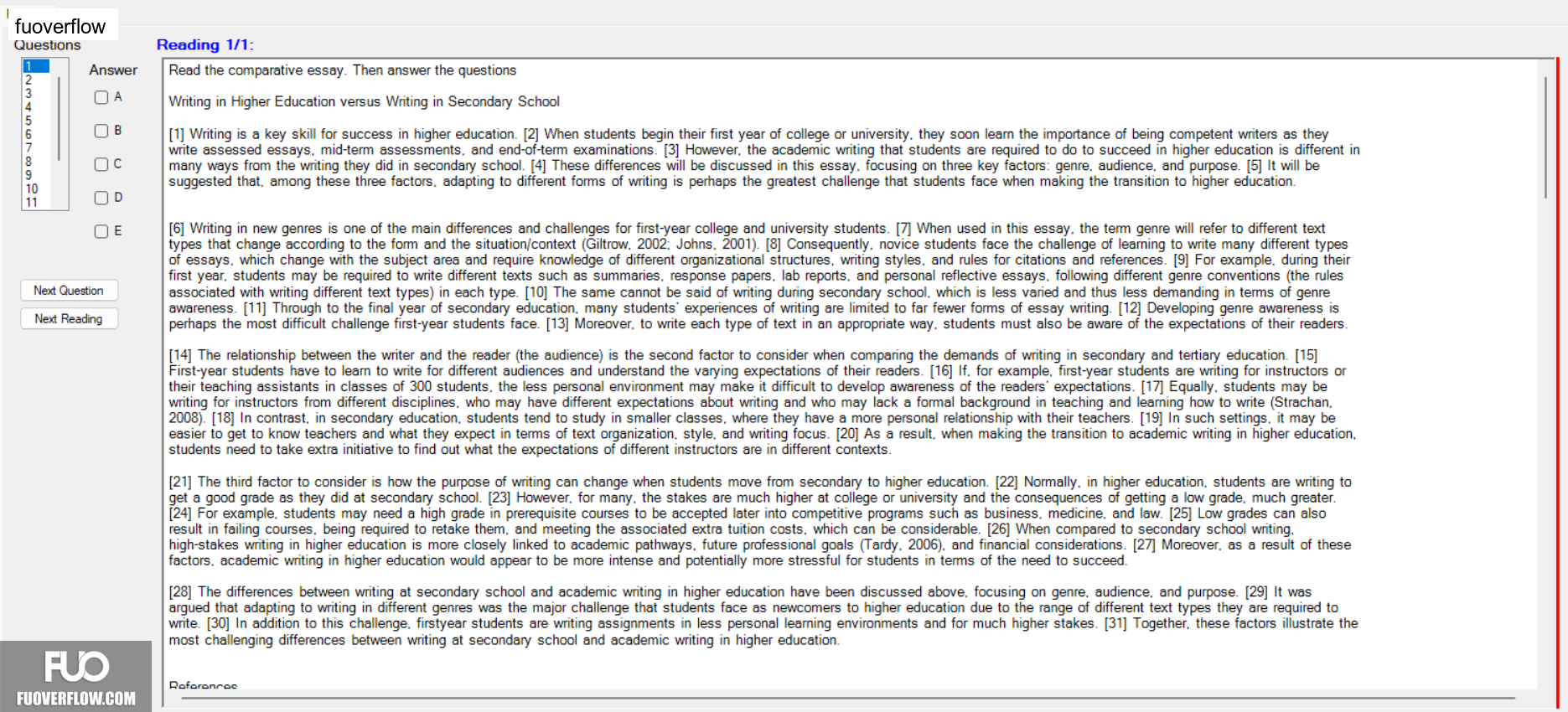
[1] Writing is a key skill for success in higher education. [2] When students begin their first year of college or university, they soon learn the importance of being competent writers as they write assessed essays, mid-term assessments, and end-of-term examinations. [3] However, the academic writing that students are required to do to succeed in higher education is different in many ways from the writing they did in secondary school. [4] These differences will be discussed in this essay, focusing on three key factors: genre, audience, and purpose. [5] It will be suggested that, among these three factors, adapting to different forms of writing is perhaps the greatest challenge that students face when making the transition to higher education.
Next Question
[6] Writing in new genres is one of the main differences and challenges for first-year college and university students. [7] When used in this essay, the term genre will refer to different text types that change according to the form and the situation/context (Giltrow, 2002; Johns, 2001). [8] Consequently, novice students face the challenge of learning to write many different types of essays, which change with the subject area and require knowledge of different organizational structures, writing styles, and rules for citations and references. [9] For example, during their first year, students may be required to write different texts such as summaries, response papers, lab reports, and personal reflective essays, following different genre conventions (the rules associated with writing different text types) in each type. [10] The same cannot be said of writing during secondary school, which is less varied and thus less demanding in terms of genre awareness. [11] Through to the final year of secondary education, many students' experiences of writing are limited to far fewer forms of essay writing. [12] Developing genre awareness is perhaps the most difficult challenge first-year students face. [13] Moreover, to write each type of text in an appropriate way, students must also be aware of the expectations of their readers.
Next Reading
[14] The relationship between the writer and the reader (the audience) is the second factor to consider when comparing the demands of writing in secondary and tertiary education. [15]First-year students have to learn to write for different audiences and understand the varying expectations of their readers. [16] If, for example, first-year students are writing for instructors or their teaching assistants in classes of 300 students, the less personal environment may make it difficult to develop awareness of the readers' expectations. [17] Equally, students may be writing for instructors from different disciplines, who may have different expectations about writing and who may lack a formal background in teaching and learning how to write (Strachan.2008). [18] In contrast, in secondary education, students tend to study in smaller classes, where they have a more personal relationship with their teachers. [19] In such settings, it may be easier to get to know teachers and what they expect in terms of text organization, style, and writing focus. [20] As a result, when making the transition to academic writing in higher education,
students need to take extra initiative to find out what the expectations of different instructors are in different contexts.
[21] The third factor to consider is how the purpose of writing can change when students move from secondary to higher education. [22] Normally, in higher education, students are writing to
get a good grade as they did at secondary school. [23] However, for many, the stakes are much higher at college or university and the consequences of getting a low grade, much greater.
[24] For example, students may need a high grade in prerequisite courses to be accepted later into competitive programs such as business, medicine, and law. [25] Low grades can also
result in failing courses, being required to retake them, and meeting the associated extra tuition costs, which can be considerable. [26] When compared to secondary school writing.
high-stakes writing in higher education is more closely linked to academic pathways, future professional goals (Tardy. 2006), and financial considerations. [27] Moreover, as a result of these
factors, academic writing in higher education would appear to be more intense and potentially more stressful for students in terms of the need to succeed.[28] The differences between writing at secondary school and academic writing in higher education have been discussed above, focusing on genre, audience, and purpose. [29] It was
argued that adapting to writing in different genres was the major challenge that students face as newcomers to higher education due to the range of different text types they are required to
write. [30] In addition to this challenge, firstyear students are writing assignments in less personal learning environments and for much higher stakes. [31] Together, these factors illustrate the
most challenging differences between writing at secondary school and academic writing in higher education.
Referancos
Questions
Reading 1/1:
OD
Read the comparative essay. Then answer the questions
234567891011
Writing in Higher Education versus Writing in Secondary School
[1] Writing is a key skill for success in higher education. [2] When students begin their first year of college or university, they soon learn the importance of being competent writers as they write assessed essays, mid-term assessments, and end-of-term examinations. [3] However, the academic writing that students are required to do to succeed in higher education is different in many ways from the writing they did in secondary school. [4] These differences will be discussed in this essay, focusing on three key factors: genre, audience, and purpose. [5] It will be suggested that, among these three factors, adapting to different forms of writing is perhaps the greatest challenge that students face when making the transition to higher education.
Next Question
[6] Writing in new genres is one of the main differences and challenges for first-year college and university students. [7] When used in this essay, the term genre will refer to different text types that change according to the form and the situation/context (Giltrow, 2002; Johns, 2001). [8] Consequently, novice students face the challenge of learning to write many different types of essays, which change with the subject area and require knowledge of different organizational structures, writing styles, and rules for citations and references. [9] For example, during their first year, students may be required to write different texts such as summaries, response papers, lab reports, and personal reflective essays, following different genre conventions (the rules associated with writing different text types) in each type. [10] The same cannot be said of writing during secondary school, which is less varied and thus less demanding in terms of genre awareness. [11] Through to the final year of secondary education, many students' experiences of writing are limited to far fewer forms of essay writing. [12] Developing genre awareness is perhaps the most difficult challenge first-year students face. [13] Moreover, to write each type of text in an appropriate way, students must also be aware of the expectations of their readers.
Next Reading
[14] The relationship between the writer and the reader (the audience) is the second factor to consider when comparing the demands of writing in secondary and tertiary education. [15]First-year students have to learn to write for different audiences and understand the varying expectations of their readers. [16] If, for example, first-year students are writing for instructors or their teaching assistants in classes of 300 students, the less personal environment may make it difficult to develop awareness of the readers' expectations. [17] Equally, students may be writing for instructors from different disciplines, who may have different expectations about writing and who may lack a formal background in teaching and learning how to write (Strachan.2008). [18] In contrast, in secondary education, students tend to study in smaller classes, where they have a more personal relationship with their teachers. [19] In such settings, it may be easier to get to know teachers and what they expect in terms of text organization, style, and writing focus. [20] As a result, when making the transition to academic writing in higher education,
students need to take extra initiative to find out what the expectations of different instructors are in different contexts.
[21] The third factor to consider is how the purpose of writing can change when students move from secondary to higher education. [22] Normally, in higher education, students are writing to
get a good grade as they did at secondary school. [23] However, for many, the stakes are much higher at college or university and the consequences of getting a low grade, much greater.
[24] For example, students may need a high grade in prerequisite courses to be accepted later into competitive programs such as business, medicine, and law. [25] Low grades can also
result in failing courses, being required to retake them, and meeting the associated extra tuition costs, which can be considerable. [26] When compared to secondary school writing.
high-stakes writing in higher education is more closely linked to academic pathways, future professional goals (Tardy. 2006), and financial considerations. [27] Moreover, as a result of these
factors, academic writing in higher education would appear to be more intense and potentially more stressful for students in terms of the need to succeed.[28] The differences between writing at secondary school and academic writing in higher education have been discussed above, focusing on genre, audience, and purpose. [29] It was
argued that adapting to writing in different genres was the major challenge that students face as newcomers to higher education due to the range of different text types they are required to
write. [30] In addition to this challenge, firstyear students are writing assignments in less personal learning environments and for much higher stakes. [31] Together, these factors illustrate the
most challenging differences between writing at secondary school and academic writing in higher education.
Referancos