Install the app
How to install the app on iOS
Follow along with the video below to see how to install our site as a web app on your home screen.
Note: This feature may not be available in some browsers.
-

Cùng tham gia nhóm của FuOverflow trên Facebook https://www.facebook.com/groups/nvh2fuoverflow
You are using an out of date browser. It may not display this or other websites correctly.
You should upgrade or use an alternative browser.
You should upgrade or use an alternative browser.

ENW492c_-_FE_-_SU_2023_-_R_692.webp
Bài viết gốc: Chủ đề 'ENW492c - FE - SU 2023 - R'
1 lestions
Reading 1/1:
and Kraft Macaroni & Cheese can leave students without energy to give all their attention to their studies.
234567891011
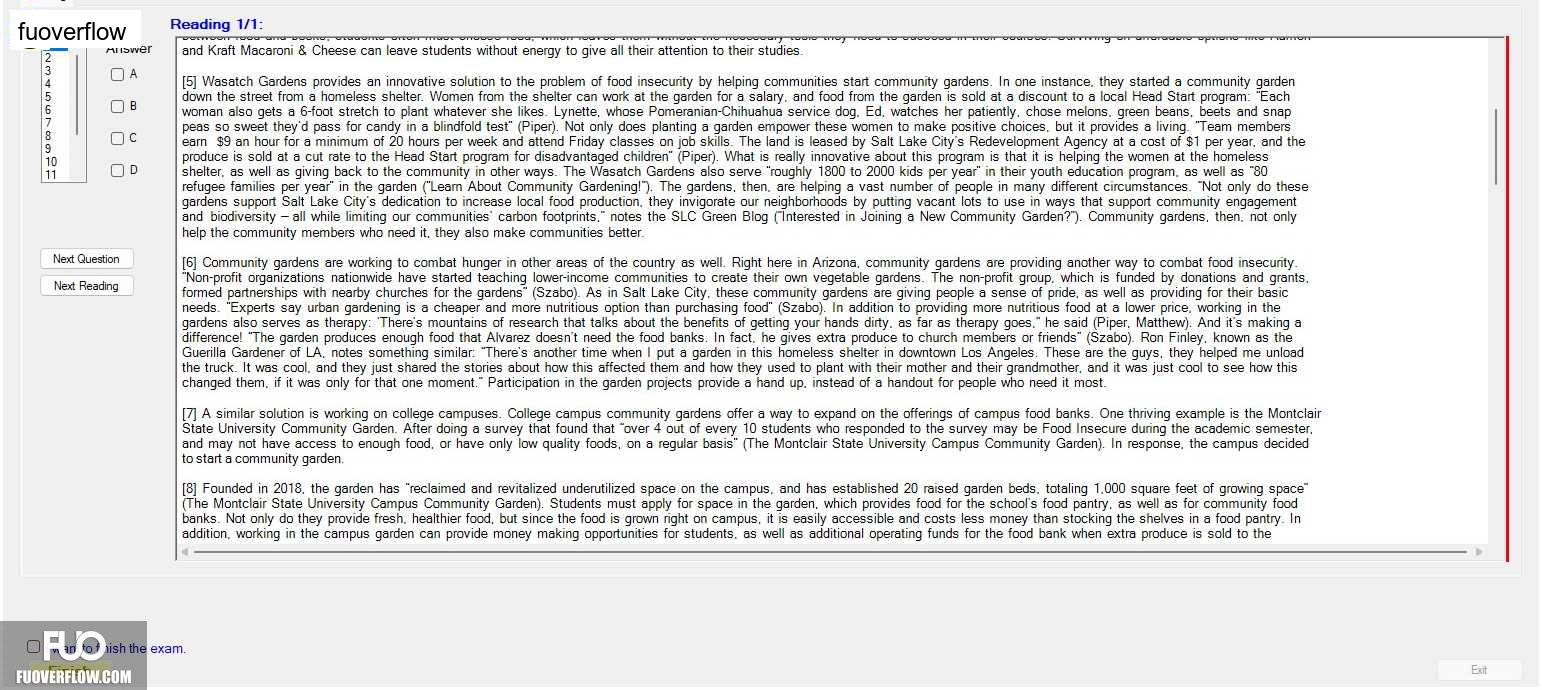
[5] Wasatch Gardens provides an innovative solution to the problem of food insecurity by helping communities start community gardens. In one instance, they started a community garden down the street from a homeless shelter. Women from the shelter can work at the garden for a salary, and food from the garden is sold at a discount to a local Head Start program: "Eachwoman also gets a 6-foot stretch to plant whatever she likes. Lynette, whose Pomeranian-Chihuahua service dog. Ed. watches her patiently, chose melons, green beans, beets and snap peas so sweet they'd pass for candy in a blindfold test" (Piper). Not only does planting a garden empower these women to make positive choices, but it provides a living. "Team members earn $9 an hour for a minimum of 20 hours per week and attend Friday classes on job skills. The land is leased by Salt Lake City's Redevelopment Agency at a cost of $1 per year, and the produce is sold at a cut rate to the Head Start program for disadvantaged children" (Piper). What is really innovative about this program is that it is helping the women at the homeless shelter, as well as giving back to the community in other ways. The Wasatch Gardens also serve "roughly 1800 to 2000 kids per year" in their youth education program, as well as "80refugee families per year" in the garden ("Learn About Community Gardening!"). The gardens, then, are helping a vast number of people in many different circumstances. "Not only do these gardens support Salt Lake City's dedication to increase local food production, they invigorate our neighborhoods by putting vacant lots to use in ways that support community engagement and biodiversity - all while limiting our communities carbon footprints." notes the SLC Green Blog (Interested in Joining a New Community Garden?"). Community gardens, then, not only help the community members who need it, they also make communities better.
Next Question
Next Reading
[6] Community gardens are working to combat hunger in other areas of the country as well. Right here in Arizona, community gardens are providing another way to combat food insecurity."Non-profit organizations nationwide have started teaching lower-income communities to create their own vegetable gardens. The non-profit group, which is funded by donations and grants.formed partnerships with nearby churches for the gardens" (Szabo). As in Salt Lake City, these community gardens are giving people a sense of pride, as well as providing for their basic needs. "Experts say urban gardening is a cheaper and more nutritious option than purchasing food" (Szabo). In addition to providing more nutritious food at a lower price, working in the gardens also serves as therapy: 'There's mountains of research that talks about the benefits of getting your hands dirty, as far as therapy goes," he said (Piper, Matthew). And it's making a difference! "The garden produces enough food that Alvarez doesn't need the food banks. In fact, he gives extra produce to church members or friends" (Szabo). Ron Finley, known as the Guerilla Gardener of LA, notes something similar: "There's another time when I put a garden in this homeless shelter in downtown Los Angeles. These are the guys, they helped me unload
the truck. It was cool, and they just shared the stories about how this affected them and how they used to plant with their mother and their grandmother, and it was just cool to see how this changed them, if it was only for that one moment." Participation in the garden projects provide a hand up, instead of a handout for people who need it most.
[7] A similar solution is working on college campuses. College campus community gardens offer a way to expand on the offerings of campus food banks. One thriving example is the Montclair State University Community Garden. After doing a survey that found that "over 4 out of every 10 students who responded to the survey may be Food Insecure during the academic semester.and may not have access to enough food, or have only low quality foods, on a regular basis" (The Montclair State University Campus Community Garden). In response, the campus decided to start a community garden.
[8] Founded in 2018, the garden has "reclaimed and revitalized underutilized space on the campus, and has established 20 raised garden beds, totaling 1.000 square feet of growing space™(The Montclair State University Campus Community Garden). Students must apply for space in the garden, which provides food for the school's food pantry, as well as for community food banks. Not only do they provide fresh, healthier food, but since the food is grown right on campus, it is easily accessible and costs less money than stocking the shelves in a food pantry. In addition, working in the campus garden can provide money making opportunities for students, as well as additional operating funds for the food bank when extra produce is sold to the
ngon
Reading 1/1:
and Kraft Macaroni & Cheese can leave students without energy to give all their attention to their studies.
234567891011
[5] Wasatch Gardens provides an innovative solution to the problem of food insecurity by helping communities start community gardens. In one instance, they started a community garden down the street from a homeless shelter. Women from the shelter can work at the garden for a salary, and food from the garden is sold at a discount to a local Head Start program: "Eachwoman also gets a 6-foot stretch to plant whatever she likes. Lynette, whose Pomeranian-Chihuahua service dog. Ed. watches her patiently, chose melons, green beans, beets and snap peas so sweet they'd pass for candy in a blindfold test" (Piper). Not only does planting a garden empower these women to make positive choices, but it provides a living. "Team members earn $9 an hour for a minimum of 20 hours per week and attend Friday classes on job skills. The land is leased by Salt Lake City's Redevelopment Agency at a cost of $1 per year, and the produce is sold at a cut rate to the Head Start program for disadvantaged children" (Piper). What is really innovative about this program is that it is helping the women at the homeless shelter, as well as giving back to the community in other ways. The Wasatch Gardens also serve "roughly 1800 to 2000 kids per year" in their youth education program, as well as "80refugee families per year" in the garden ("Learn About Community Gardening!"). The gardens, then, are helping a vast number of people in many different circumstances. "Not only do these gardens support Salt Lake City's dedication to increase local food production, they invigorate our neighborhoods by putting vacant lots to use in ways that support community engagement and biodiversity - all while limiting our communities carbon footprints." notes the SLC Green Blog (Interested in Joining a New Community Garden?"). Community gardens, then, not only help the community members who need it, they also make communities better.
Next Question
Next Reading
[6] Community gardens are working to combat hunger in other areas of the country as well. Right here in Arizona, community gardens are providing another way to combat food insecurity."Non-profit organizations nationwide have started teaching lower-income communities to create their own vegetable gardens. The non-profit group, which is funded by donations and grants.formed partnerships with nearby churches for the gardens" (Szabo). As in Salt Lake City, these community gardens are giving people a sense of pride, as well as providing for their basic needs. "Experts say urban gardening is a cheaper and more nutritious option than purchasing food" (Szabo). In addition to providing more nutritious food at a lower price, working in the gardens also serves as therapy: 'There's mountains of research that talks about the benefits of getting your hands dirty, as far as therapy goes," he said (Piper, Matthew). And it's making a difference! "The garden produces enough food that Alvarez doesn't need the food banks. In fact, he gives extra produce to church members or friends" (Szabo). Ron Finley, known as the Guerilla Gardener of LA, notes something similar: "There's another time when I put a garden in this homeless shelter in downtown Los Angeles. These are the guys, they helped me unload
the truck. It was cool, and they just shared the stories about how this affected them and how they used to plant with their mother and their grandmother, and it was just cool to see how this changed them, if it was only for that one moment." Participation in the garden projects provide a hand up, instead of a handout for people who need it most.
[7] A similar solution is working on college campuses. College campus community gardens offer a way to expand on the offerings of campus food banks. One thriving example is the Montclair State University Community Garden. After doing a survey that found that "over 4 out of every 10 students who responded to the survey may be Food Insecure during the academic semester.and may not have access to enough food, or have only low quality foods, on a regular basis" (The Montclair State University Campus Community Garden). In response, the campus decided to start a community garden.
[8] Founded in 2018, the garden has "reclaimed and revitalized underutilized space on the campus, and has established 20 raised garden beds, totaling 1.000 square feet of growing space™(The Montclair State University Campus Community Garden). Students must apply for space in the garden, which provides food for the school's food pantry, as well as for community food banks. Not only do they provide fresh, healthier food, but since the food is grown right on campus, it is easily accessible and costs less money than stocking the shelves in a food pantry. In addition, working in the campus garden can provide money making opportunities for students, as well as additional operating funds for the food bank when extra produce is sold to the
ngon
Image metadata
- Filename
- ENW492c_-_FE_-_SU_2023_-_R_692.webp
- File size
- 193.4 KB
- Dimensions
- 1542px x 690px