Install the app
How to install the app on iOS
Follow along with the video below to see how to install our site as a web app on your home screen.
Note: This feature may not be available in some browsers.
-

Cùng tham gia nhóm của FuOverflow trên Facebook https://www.facebook.com/groups/nvh2fuoverflow
You are using an out of date browser. It may not display this or other websites correctly.
You should upgrade or use an alternative browser.
You should upgrade or use an alternative browser.
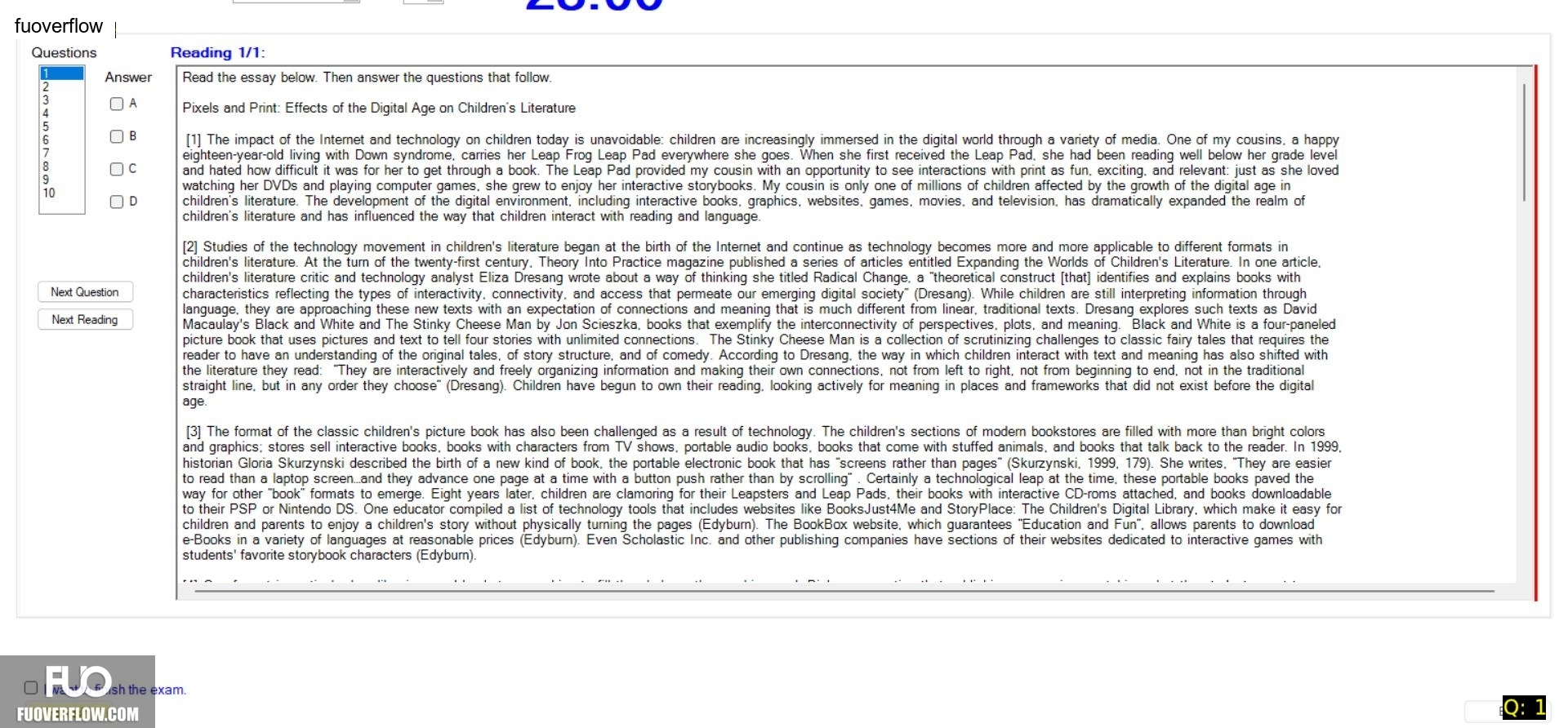
Bài viết gốc: Chủ đề 'ENW492c - R - RESP24'
Questions
Reading 1/1:
Read the essay below. Then answer the questions that follow.
12345678910
Pixels and Print: Effects of the Digital Age on Children's Literature
[1] The impact of the Internet and technology on children today is unavoidable: children are increasingly immersed in the digital world through a variety of media. One of my cousins, a happy eighteen-year-old living with Down syndrome, carries her Leap Frog Leap Pad everywhere she goes. When she first received the Leap Pad, she had been reading well below her grade level and hated how difficult it was for her to get through a book. The Leap Pad provided my cousin with an opportunity to see interactions with print as fun, exciting, and relevant: just as she loved watching her DVDs and playing computer games, she grew to enjoy her interactive storybooks. My cousin is only one of millions of children affected by the growth of the digital age in children's literature. The development of the digital environment, including interactive books, graphics, websites, games, movies, and television, has dramatically expanded the realm of children's literature and has influenced the way that children interact with reading and language.
Next Question
Next Reading
[2] Studies of the technology movement in children's literature began at the birth of the Internet and continue as technology becomes more and more applicable to different formats in children's literature. At the turn of the twenty-first century. Theory Into Practice magazine published a series of articles entitled Expanding the Worlds of Children's Literature. In one article.children's literature critic and technology analyst Eliza Dresang wrote about a way of thinking she titled Radical Change, a "theoretical construct [that] identifies and explains books with characteristics reflecting the types of interactivity, connectivity, and access that permeate our emerging digital society" (Dresang). While children are still interpreting information through language, they are approaching these new texts with an expectation of connections and meaning that is much different from linear, traditional texts. Dresang explores such texts as David Macaulay's Black and White and The Stinky Cheese Man by Jon Scieszka, books that exemplify the interconnectivity of perspectives, plots, and meaning. Black and White is a four-paneled picture book that uses pictures and text to tell four stories with unlimited connections. The Stinky Cheese Man is a collection of scrutinizing challenges to classic fairy tales that requires the reader to have an understanding of the original tales, of story structure, and of comedy. According to Dresang, the way in which children interact with text and meaning has also shifted with the literature they read: "They are interactively and freely organizing information and making their own connections, not from left to right, not from beginning to end, not in the traditional straight line, but in any order they choose" (Dresang). Children have begun to own their reading, looking actively for meaning in places and frameworks that did not exist before the digital
age.
[3] The format of the classic children's picture book has also been challenged as a result of technology. The children's sections of modern bookstores are filled with more than bright colors
and graphics; stores sell interactive books, books with characters from TV shows, portable audio books, books that come with stuffed animals, and books that talk back to the reader. In 1999,historian Gloria Skurzynski described the birth of a new kind of book, the portable electronic book that has "screens rather than pages" (Skurzynski, 1999, 179). She writes. "They are easier to read than a laptop screen...and they advance one page at a time with a button push rather than by scrolling". Certainly a technological leap at the time, these portable books paved the way for other "book" formats to emerge. Eight years later, children are clamoring for their Leapsters and Leap Pads, their books with interactive CD-roms attached, and books downloadable to their PSP or Nintendo DS. One educator compiled a list of technology tools that includes websites like Books Just4Me and StoryPlace: The Children's Digital Library, which make it easy for children and parents to enjoy a children's story without physically turning the pages (Edyburn). The BookBox website, which guarantees "Education and Fun", allows parents to download e-Books in a variety of languages at reasonable prices (Edyburn). Even Scholastic Inc. and other publishing companies have sections of their websites dedicated to interactive games with
students' favorite storybook characters (Edyburn).
2: 1
Reading 1/1:
Read the essay below. Then answer the questions that follow.
12345678910
Pixels and Print: Effects of the Digital Age on Children's Literature
[1] The impact of the Internet and technology on children today is unavoidable: children are increasingly immersed in the digital world through a variety of media. One of my cousins, a happy eighteen-year-old living with Down syndrome, carries her Leap Frog Leap Pad everywhere she goes. When she first received the Leap Pad, she had been reading well below her grade level and hated how difficult it was for her to get through a book. The Leap Pad provided my cousin with an opportunity to see interactions with print as fun, exciting, and relevant: just as she loved watching her DVDs and playing computer games, she grew to enjoy her interactive storybooks. My cousin is only one of millions of children affected by the growth of the digital age in children's literature. The development of the digital environment, including interactive books, graphics, websites, games, movies, and television, has dramatically expanded the realm of children's literature and has influenced the way that children interact with reading and language.
Next Question
Next Reading
[2] Studies of the technology movement in children's literature began at the birth of the Internet and continue as technology becomes more and more applicable to different formats in children's literature. At the turn of the twenty-first century. Theory Into Practice magazine published a series of articles entitled Expanding the Worlds of Children's Literature. In one article.children's literature critic and technology analyst Eliza Dresang wrote about a way of thinking she titled Radical Change, a "theoretical construct [that] identifies and explains books with characteristics reflecting the types of interactivity, connectivity, and access that permeate our emerging digital society" (Dresang). While children are still interpreting information through language, they are approaching these new texts with an expectation of connections and meaning that is much different from linear, traditional texts. Dresang explores such texts as David Macaulay's Black and White and The Stinky Cheese Man by Jon Scieszka, books that exemplify the interconnectivity of perspectives, plots, and meaning. Black and White is a four-paneled picture book that uses pictures and text to tell four stories with unlimited connections. The Stinky Cheese Man is a collection of scrutinizing challenges to classic fairy tales that requires the reader to have an understanding of the original tales, of story structure, and of comedy. According to Dresang, the way in which children interact with text and meaning has also shifted with the literature they read: "They are interactively and freely organizing information and making their own connections, not from left to right, not from beginning to end, not in the traditional straight line, but in any order they choose" (Dresang). Children have begun to own their reading, looking actively for meaning in places and frameworks that did not exist before the digital
age.
[3] The format of the classic children's picture book has also been challenged as a result of technology. The children's sections of modern bookstores are filled with more than bright colors
and graphics; stores sell interactive books, books with characters from TV shows, portable audio books, books that come with stuffed animals, and books that talk back to the reader. In 1999,historian Gloria Skurzynski described the birth of a new kind of book, the portable electronic book that has "screens rather than pages" (Skurzynski, 1999, 179). She writes. "They are easier to read than a laptop screen...and they advance one page at a time with a button push rather than by scrolling". Certainly a technological leap at the time, these portable books paved the way for other "book" formats to emerge. Eight years later, children are clamoring for their Leapsters and Leap Pads, their books with interactive CD-roms attached, and books downloadable to their PSP or Nintendo DS. One educator compiled a list of technology tools that includes websites like Books Just4Me and StoryPlace: The Children's Digital Library, which make it easy for children and parents to enjoy a children's story without physically turning the pages (Edyburn). The BookBox website, which guarantees "Education and Fun", allows parents to download e-Books in a variety of languages at reasonable prices (Edyburn). Even Scholastic Inc. and other publishing companies have sections of their websites dedicated to interactive games with
students' favorite storybook characters (Edyburn).
2: 1
Image metadata
- Filename
- ENW492c_-_R_-_RESP24_1959.webp
- File size
- 886.3 KB
- Dimensions
- 1920px x 892px