Questions
2345
Reading 2/2:
Now read the article.
THE PRINTING PRESS
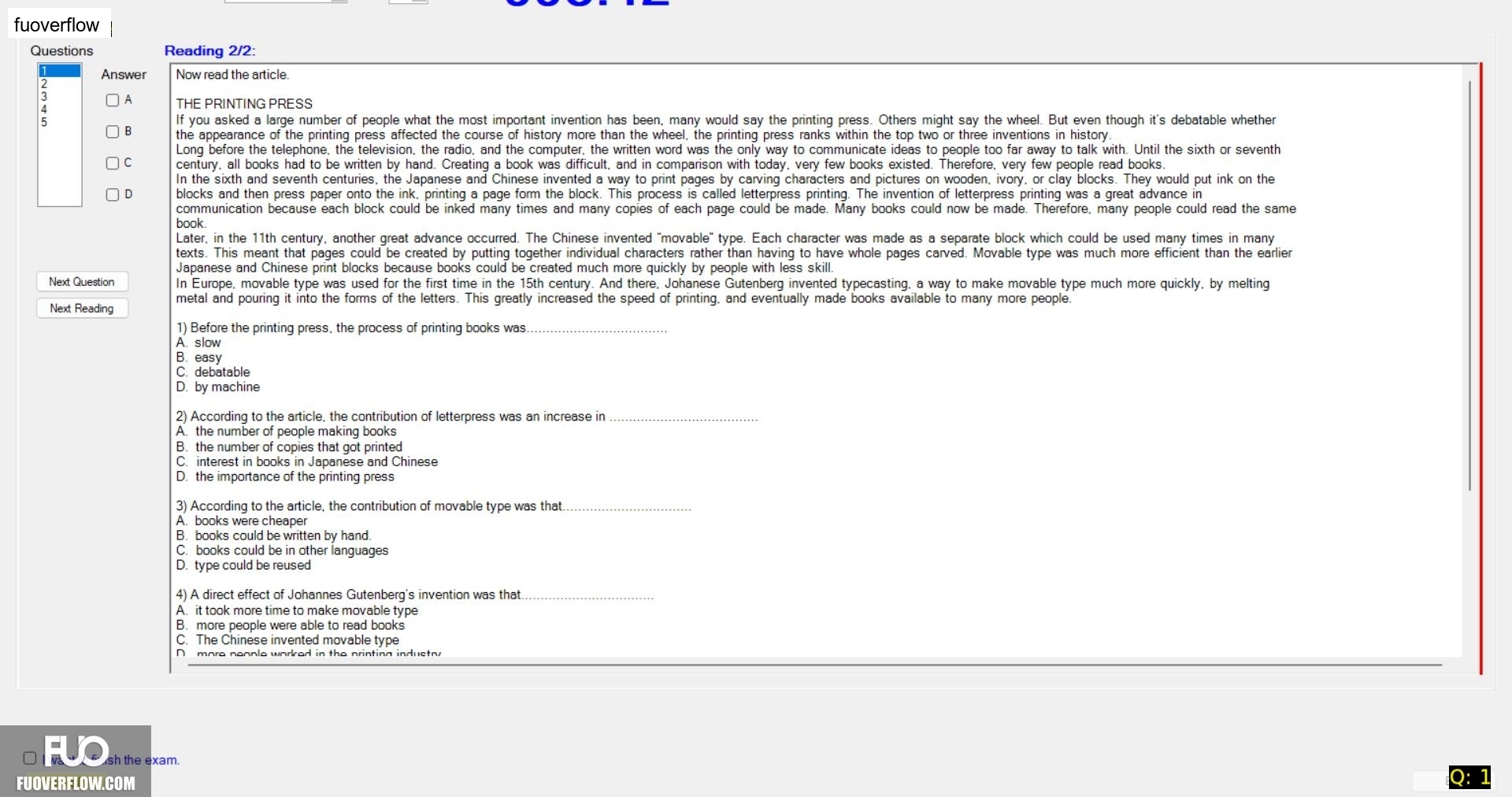
A If you asked a large number of people what the most important invention has been, many would say the printing press. Others might say the wheel. But even though it's debatable whether the appearance of the printing press affected the course of history more than the wheel, the printing press ranks within the top two or three inventions in history.people too far away to talk with. Until the sixth or seventh
Long before the telephone, the television, the radio, and the computer, the written word was the only way to communicate ideas to century, all books had to be written by hand. Creating a book was difficult, and in comparison with today, very few books existed. Therefore, very few people read books.In the sixth and seventh centuries, the Japanese nese and Chinese invented a way to print pages by carving characters and pictures on wooden, ivory, or clay blocks. They would put ink on the blocks and then press paper onto the ink, printing a page form the block. This process is called letterpress printing. The invention of letterpress printing was a great advance in communication because each block could be inked many times and many copies of each page could be made. Many books could now be made. Therefore, many people could read the same book.
Later, in the 11th century, another great advance occurred. The Chinese invented "movable" type. Each character was made as a separate block which could be used many times in many texts. This meant that pages could be created by putting together individual characters rather than having to have whole pages carved. Movable type was much more efficient than the earlier Japanese and Chinese print blocks because books could be created much more quickly by people with less skill.
In Europe, movable type was used for the first time in the 15th century. And there, Johanese Gutenberg invented typecasting, a way to make movable type much more quickly, by melting metal and pouring it into the forms of the letters. This greatly increased the speed of printing, and eventually made books available to many more people.
Next Question
Next Reading
Π
1
1) Before the printing press, the process of printing books was.
A. slow
B. easy
C. debatable
D. by machine
2) According to the article, the contribution of letterpress was an increase in
A. the number of people making books
B. the number of copies that got printed C. interest in books in Japanese and Chinese
D. the importance of the printing press
3) According to the article, the contribution of movable type was that.
A. books were cheaper
B. books could be written by hand.C. books could be in other languages
D. type could be reused
4) A direct effect of Johannes Gutenberg's invention was that.
A. it took more time to make movable type B. more people were able to read books
C. The Chinese invented movable type mora nonnia worked in the printing industry