-

Cùng tham gia nhóm của FuOverflow trên Facebook https://www.facebook.com/groups/nvh2fuoverflow
K
PRP201c_-_SP_2025_-_PE1_3810.webp
Bài viết gốc: Chủ đề 'PRP201c - SP 2025 - PE1'
☑Kizspy.me
•
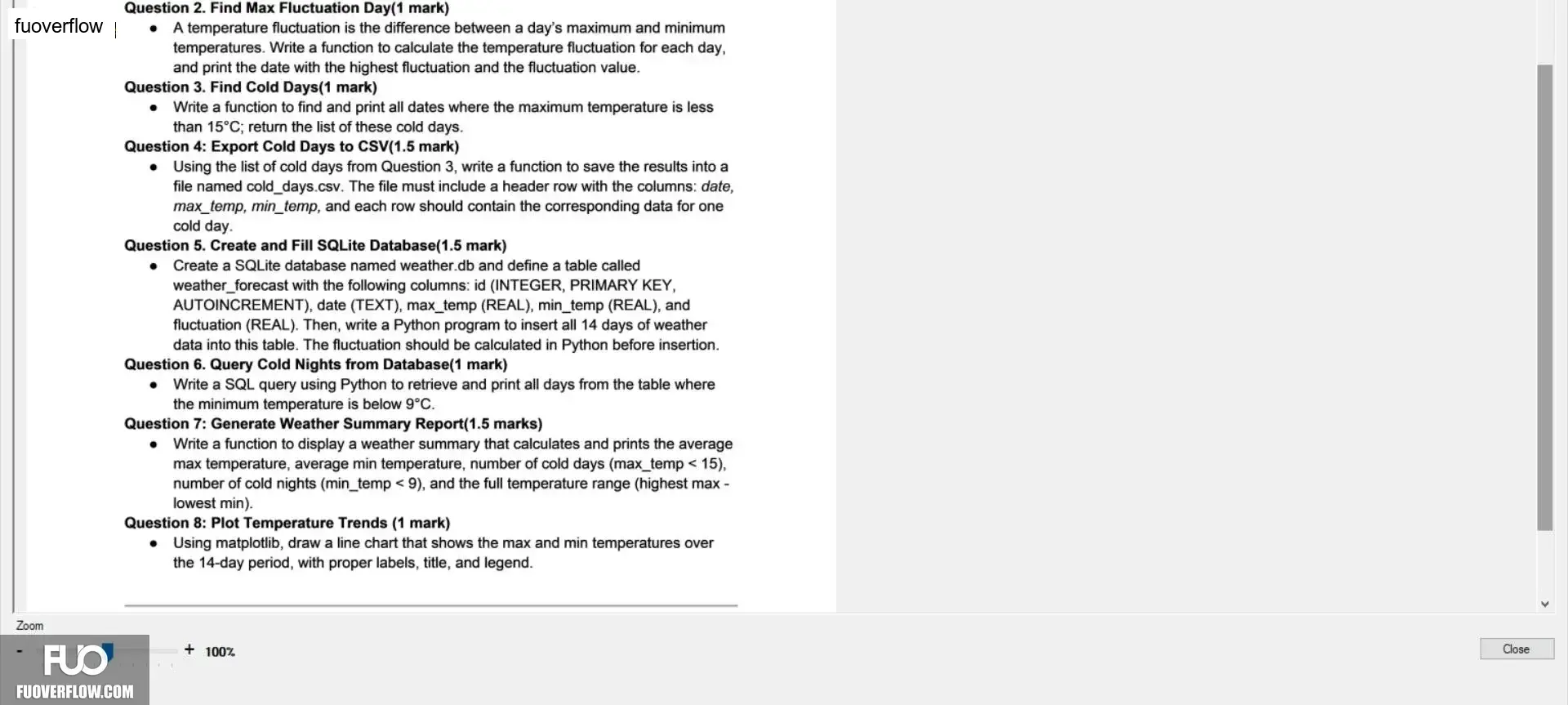
Question 2. Find Max Fluctuation Day(1 mark)
A temperature fluctuation is the difference between a day's maximum and minimum
temperatures. Write a function to calculate the temperature fluctuation for each day,
and print the date with the highest fluctuation and the fluctuation value.
Question 3. Find Cold Days(1 mark)
• Write a function to find and print all dates where the maximum temperature is less
than 15°C; return the list of these cold days.
Question 4: Export Cold Days to CSV(1.5 mark)
• Using the list of cold days from Question 3, write a function to save the results into a
file named cold_days.csv. The file must include a header row with the columns: date,
max_temp, min_temp, and each row should contain the corresponding data for one
cold day.
Question 5. Create and Fill SQLite Database(1.5 mark)
Create a SQLite database named weather.db and define a table called
weather forecast with the following columns: id (INTEGER, PRIMARY KEY,
AUTOINCREMENT), date (TEXT), max_temp (REAL), min_temp (REAL), and
fluctuation (REAL). Then, write a Python program to insert all 14 days of weather
data into this table. The fluctuation should be calculated in Python before insertion.
Question 6. Query Cold Nights from Database(1 mark)
• Write a SQL query using Python to retrieve and print all days from the table where
the minimum temperature is below 9°C.
Question 7: Generate Weather Summary Report(1.5 marks)
• Write a function to display a weather summary that calculates and prints the average
max temperature, average min temperature, number of cold days (max_temp < 15),
number of cold nights (min_temp <9), and the full temperature range (highest max -
lowest min).
Question 8: Plot Temperature Trends (1 mark)
 Using matplotlib, draw a line chart that shows the max and min temperatures over
the 14-day period, with proper labels, title, and legend.
Zoom
+ 100%
Close
•
Question 2. Find Max Fluctuation Day(1 mark)
A temperature fluctuation is the difference between a day's maximum and minimum
temperatures. Write a function to calculate the temperature fluctuation for each day,
and print the date with the highest fluctuation and the fluctuation value.
Question 3. Find Cold Days(1 mark)
• Write a function to find and print all dates where the maximum temperature is less
than 15°C; return the list of these cold days.
Question 4: Export Cold Days to CSV(1.5 mark)
• Using the list of cold days from Question 3, write a function to save the results into a
file named cold_days.csv. The file must include a header row with the columns: date,
max_temp, min_temp, and each row should contain the corresponding data for one
cold day.
Question 5. Create and Fill SQLite Database(1.5 mark)
Create a SQLite database named weather.db and define a table called
weather forecast with the following columns: id (INTEGER, PRIMARY KEY,
AUTOINCREMENT), date (TEXT), max_temp (REAL), min_temp (REAL), and
fluctuation (REAL). Then, write a Python program to insert all 14 days of weather
data into this table. The fluctuation should be calculated in Python before insertion.
Question 6. Query Cold Nights from Database(1 mark)
• Write a SQL query using Python to retrieve and print all days from the table where
the minimum temperature is below 9°C.
Question 7: Generate Weather Summary Report(1.5 marks)
• Write a function to display a weather summary that calculates and prints the average
max temperature, average min temperature, number of cold days (max_temp < 15),
number of cold nights (min_temp <9), and the full temperature range (highest max -
lowest min).
Question 8: Plot Temperature Trends (1 mark)
Using matplotlib, draw a line chart that shows the max and min temperatures overthe 14-day period, with proper labels, title, and legend.
Zoom
+ 100%
Close