Question:
Real size
Zoom out
Drag the red vertical line to resize the question/typing area
. Press Delete/Backspace key to delete a leter, "Tab" key to insert TAB character.
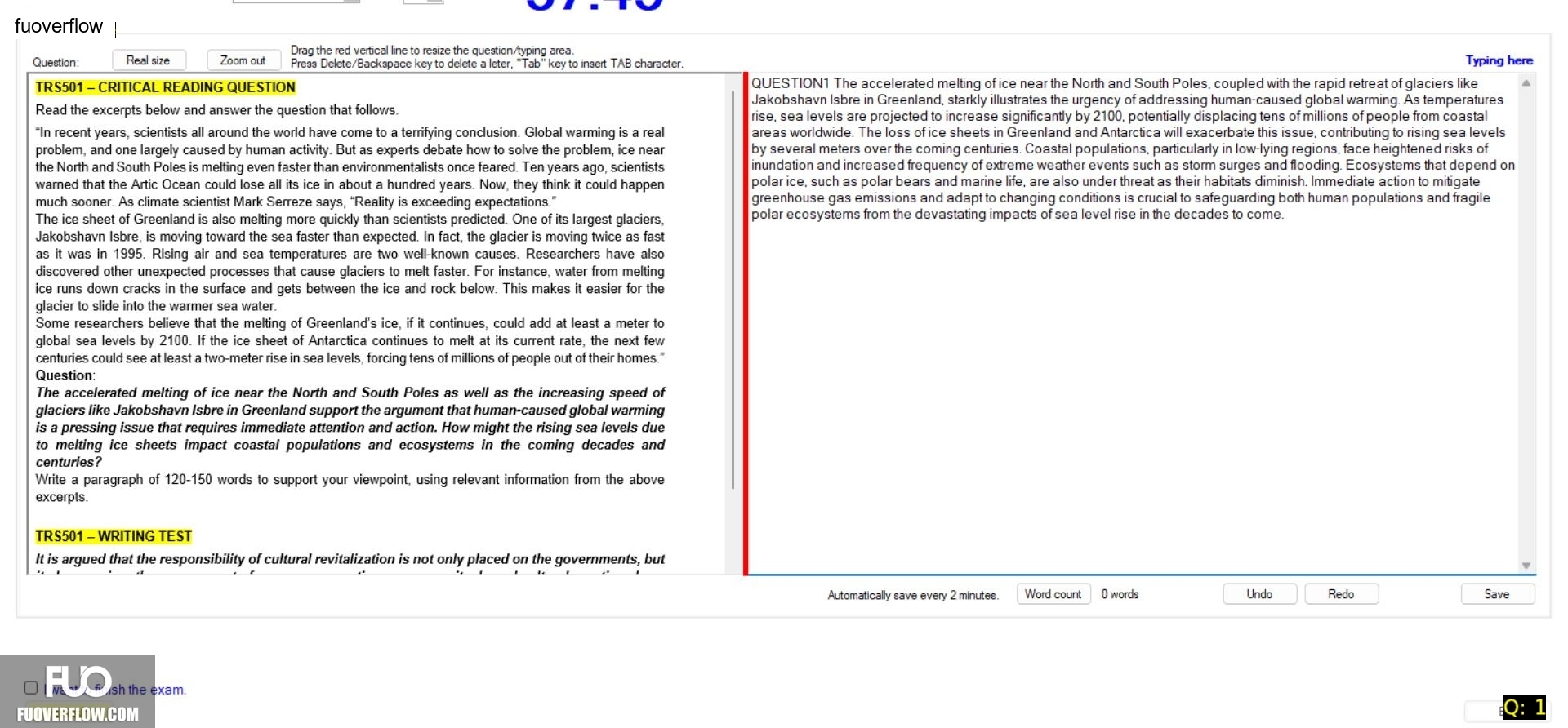
TRS501-CRITICAL READING QUESTION
Read the excerpts below and answer the question that follows.
"In recent years, scientists all around the world have come to a terrifying conclusion. Global warming is a real problem, and one largely caused by human activity. But as experts debate how to solve the problem, ice near the North and South Poles is melting even faster than environmentalists once feared. Ten years ago, scientists warned that the Artic Ocean could lose all its ice in about a hundred years. Now, they think it could happen much sooner. As climate scientist Mark Serreze says, "Reality is exceeding expectations."
The ice sheet of Greenland is also melting more quickly than scientists predicted. One of its largest glaciers,Jakobshavn Isbre, is moving toward the sea faster than expected. In fact, the glacier is moving twice as fast as it was in 1995. Rising air and sea temperatures are two well-known causes. Researchers have also discovered other unexpected processes that cause glaciers to melt faster. For instance, water from melting
ice runs down cracks in the surface and gets between the ice and rock below. This makes it easier for the glacier to slide into the warmer sea water.
Some researchers believe that the melting of Greenland's ice, if it continues, could add at least a meter to global sea levels by 2100. If the ice sheet of Antarctica continues to melt at its current rate, the next few centuries could see at least a two-meter rise in sea levels, forcing tens of millions of people out of their homes."
Question:
The accelerated melting of ice near the North and South Poles as well as the increasing speed of glaciers like Jakobshavn Isbre in Greenland support the argument that human-caused global warming is a pressing issue that requires immediate attention and action. How might the rising sea levels due to melting ice sheets impact coastal populations and ecosystems in the coming decades and centuries?
Write a paragraph of 120-150 words to support your viewpoint, using relevant information from the above excerpts.
TRS501-WRITING TEST
It is argued that the responsibility of cultural revitalization is not only placed on the governments, but
QUESTION1 The accelerated melting of ice near the North and South Poles, coupled with the rapid retreat of glaciers like Jakobshavn Isbre in Greenland, starkly illustrates the urgency of addressing human-caused global warming. As temperatures
rise, sea levels are projected to increase significantly by 2100, potentially displacing tens of millions of people from coastal areas worldwide. The loss of ice sheets in Greenland and Antarctica will exacerbate this issue, contributing to rising sea levels by several meters over the coming centuries. Coastal populations, particularly in low-lying regions, face heightened risks of inundation and increased frequency of extreme weather events such as storm surges and flooding. Ecosystems that depend on polar ice, such as polar bears and marine life, are also under threat as their habitats diminish. Immediate action to mitigate greenhouse gas emissions and adapt to changing conditions is crucial to safeguarding both human populations and fragile
polar ecosystems from the devastating impacts of sea level rise in the decades to come.
Automatically save every 2 minutes.
Word count 0 words
Undo
Redo
Save
2: 1
Typing here