Install the app
How to install the app on iOS
Follow along with the video below to see how to install our site as a web app on your home screen.
Note: This feature may not be available in some browsers.
-

Cùng tham gia nhóm của FuOverflow trên Facebook https://www.facebook.com/groups/nvh2fuoverflow
You are using an out of date browser. It may not display this or other websites correctly.
You should upgrade or use an alternative browser.
You should upgrade or use an alternative browser.
K
TRS601_-_E_-_RF23_-_P1_901.webp
Bài viết gốc: Chủ đề 'TRS601 - E - RF23 - P1'
Reading 1/1:
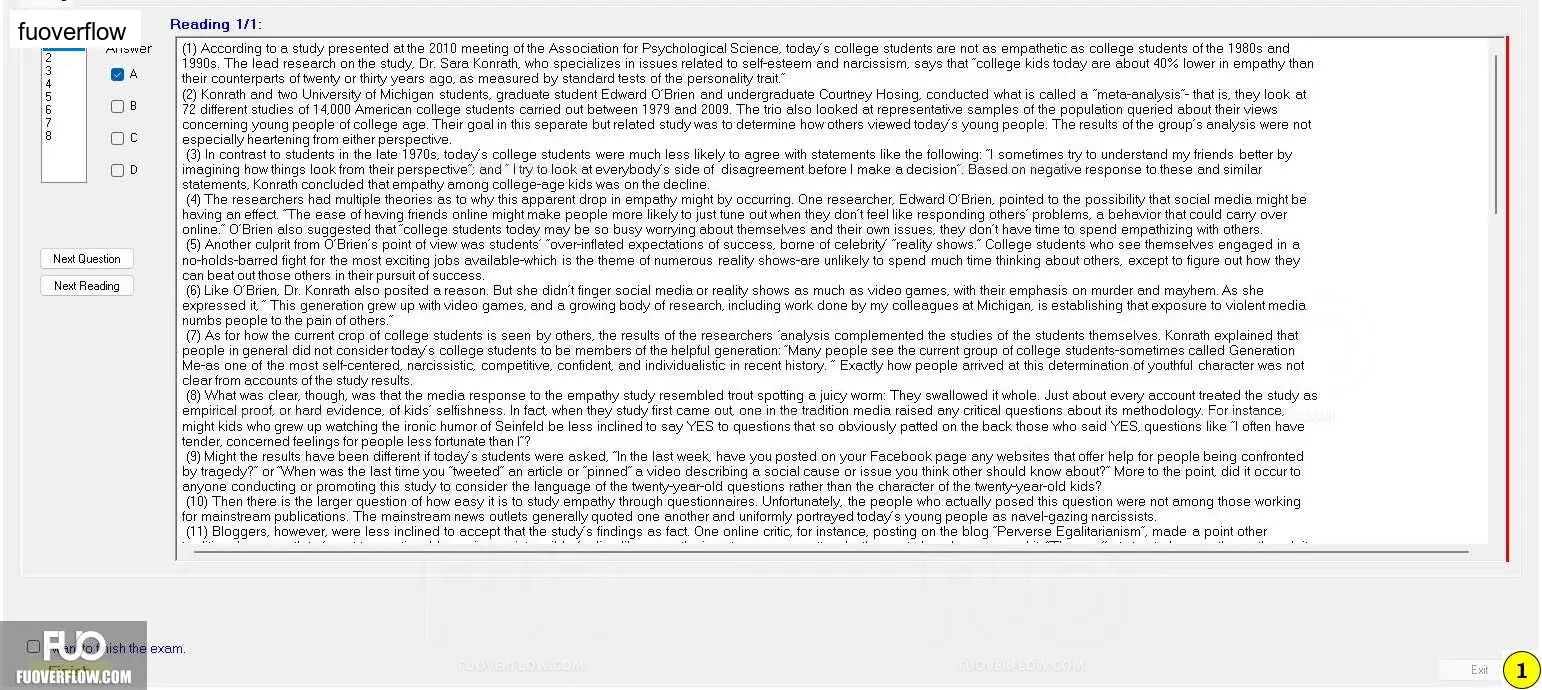
(1) According to a study presented at the 2010 meeting of the Association for Psychological Science, today's college students are not as empathetic as college students of the 1980s and
1990s. The lead research on the study, Dr. Sara Konrath, who specializes in issues related to self-esteem and narcissism, says that "college kids today are about 40% lower in empathy than
2345678
their counterparts of twenty or thirty years ago, as measured by standard tests of the personality trait."(2) Konrath and two University of Michigan students, graduate student Edward O'Brien and undergraduate Courtney Hosing, conducted what is called a "meta-analysis"- that is, they look at 72 different studies of 14,000 American college students carried out between 1979 and 2009. The trio also looked at representative samples of the population queried about their views concerning young people of college age. Their goal in this separate but related study was to determine how others viewed today's young people. The results of the group's analysis were not especially heartening from either perspective.
(3) In contrast to students in the late 1970s, today's college students were much less likely to agree with statements like the following: "I sometimes try to understand my friends better by
imagining how things look from their perspective"; and I try to look at everybody's side of disagreement before I make a decision. Based on negative response to these and similar
statements, Konrath concluded that empathy among college-age kids was on the decline.
(4) The researchers had multiple theories as to why this apparent drop in empathy might by occurring. One researcher, Edward O'Brien, pointed to the possibility that social media might be having an effect. "The ease of having friends online might make people more likely to just tune out when they don't feel like responding others problems, a behavior that could carry over online." O'Brien also suggested that college students today may be so busy worrying about themselves and their own issues, they don't have time to spend empathizing with others.
Next Question
(5) Another culprit from O'Brien's point of view was students "over-inflated expectations of success, borne of celebrity "reality shows." College students who see themselves engaged in a no-holds-barred fight for the most exciting jobs available-which is the theme of numerous reality shows-are unlikely to spend much time thinking about others, except to figure out how they can beat out those others in their pursuit of success.
Next Reading
(6) Like O'Brien, Dr. Konrath also posited a reason. But she didn't finger social media or reality shows as much as video games, with their emphasis on murder and mayhem. As she expressed it." This generation grew up with video games, and a growing body of research, including work done by my colleagues at Michigan, is establishing that exposure to violent media
numbs people to the pain of others."
(7) As for how the current crop of college students is seen by others, the results of the researchers analysis complemented the studies of the students themselves. Konrath explained that
people in general did not consider today's college students to be members of the helpful generation: "Many people see the current group of college students-sometimes called Generation Me-as one of the most self-centered, narcissistic, competitive, confident, and individualistic in recent history." Exactly how people arrived at this determination of youthful character was not clear from accounts of the study results.
(8) What was clear, though, was that the media response to the empathy study resembled trout spotting a juicy worm: They swallowed it whole. Just about every account treated the study as empirical proof, or hard evidence, of kids' selfishness. In fact, when they study first came out one in the tradition media raised any critical questions about its methodology. For instance,might kids who grew up watching the ironic humor of Seinfeld be less inclined to say YES to questions that so obviously patted on the back those who said YES, questions like "I often have
tender, concerned feelings for people less fortunate than I"?
(9) Might the results have been different if today's students were asked, "In the last week, have you posted on your Facebook page any websites that offer help for people being confronted by tragedy?" or "When was the last time you "tweeted" an article or "pinned" a video describing a social cause or issue you think other should know about?" More to the point, did it occur to anyone conducting or promoting this study to consider the language of the twenty-year-old questions rather than the character of the twenty-year-old kids?
(10) Then there is the larger question of how easy it is to study empathy through questionnaires. Unfortunately, the people who actually posed this question were not among those working for mainstream publications. The mainstream news outlets generally quoted one another and uniformly portrayed today's young people as navel-gazing narcissists.(11) Bloggers, however, were less inclined to accept that the study's findings as fact. One online critic, for instance, posting on the blog "Perverse Egalitarianism", made a point other
1
(1) According to a study presented at the 2010 meeting of the Association for Psychological Science, today's college students are not as empathetic as college students of the 1980s and
1990s. The lead research on the study, Dr. Sara Konrath, who specializes in issues related to self-esteem and narcissism, says that "college kids today are about 40% lower in empathy than
2345678
their counterparts of twenty or thirty years ago, as measured by standard tests of the personality trait."(2) Konrath and two University of Michigan students, graduate student Edward O'Brien and undergraduate Courtney Hosing, conducted what is called a "meta-analysis"- that is, they look at 72 different studies of 14,000 American college students carried out between 1979 and 2009. The trio also looked at representative samples of the population queried about their views concerning young people of college age. Their goal in this separate but related study was to determine how others viewed today's young people. The results of the group's analysis were not especially heartening from either perspective.
(3) In contrast to students in the late 1970s, today's college students were much less likely to agree with statements like the following: "I sometimes try to understand my friends better by
imagining how things look from their perspective"; and I try to look at everybody's side of disagreement before I make a decision. Based on negative response to these and similar
statements, Konrath concluded that empathy among college-age kids was on the decline.
(4) The researchers had multiple theories as to why this apparent drop in empathy might by occurring. One researcher, Edward O'Brien, pointed to the possibility that social media might be having an effect. "The ease of having friends online might make people more likely to just tune out when they don't feel like responding others problems, a behavior that could carry over online." O'Brien also suggested that college students today may be so busy worrying about themselves and their own issues, they don't have time to spend empathizing with others.
Next Question
(5) Another culprit from O'Brien's point of view was students "over-inflated expectations of success, borne of celebrity "reality shows." College students who see themselves engaged in a no-holds-barred fight for the most exciting jobs available-which is the theme of numerous reality shows-are unlikely to spend much time thinking about others, except to figure out how they can beat out those others in their pursuit of success.
Next Reading
(6) Like O'Brien, Dr. Konrath also posited a reason. But she didn't finger social media or reality shows as much as video games, with their emphasis on murder and mayhem. As she expressed it." This generation grew up with video games, and a growing body of research, including work done by my colleagues at Michigan, is establishing that exposure to violent media
numbs people to the pain of others."
(7) As for how the current crop of college students is seen by others, the results of the researchers analysis complemented the studies of the students themselves. Konrath explained that
people in general did not consider today's college students to be members of the helpful generation: "Many people see the current group of college students-sometimes called Generation Me-as one of the most self-centered, narcissistic, competitive, confident, and individualistic in recent history." Exactly how people arrived at this determination of youthful character was not clear from accounts of the study results.
(8) What was clear, though, was that the media response to the empathy study resembled trout spotting a juicy worm: They swallowed it whole. Just about every account treated the study as empirical proof, or hard evidence, of kids' selfishness. In fact, when they study first came out one in the tradition media raised any critical questions about its methodology. For instance,might kids who grew up watching the ironic humor of Seinfeld be less inclined to say YES to questions that so obviously patted on the back those who said YES, questions like "I often have
tender, concerned feelings for people less fortunate than I"?
(9) Might the results have been different if today's students were asked, "In the last week, have you posted on your Facebook page any websites that offer help for people being confronted by tragedy?" or "When was the last time you "tweeted" an article or "pinned" a video describing a social cause or issue you think other should know about?" More to the point, did it occur to anyone conducting or promoting this study to consider the language of the twenty-year-old questions rather than the character of the twenty-year-old kids?
(10) Then there is the larger question of how easy it is to study empathy through questionnaires. Unfortunately, the people who actually posed this question were not among those working for mainstream publications. The mainstream news outlets generally quoted one another and uniformly portrayed today's young people as navel-gazing narcissists.(11) Bloggers, however, were less inclined to accept that the study's findings as fact. One online critic, for instance, posting on the blog "Perverse Egalitarianism", made a point other
1
Thông tin
- Category
- TRANS 6
- Thêm bởi
- Kokichi2005
- Ngày thêm
- Lượt xem
- 177
- Lượt bình luận
- 0
- Rating
- 0.00 star(s) 0 đánh giá
Image metadata
- Filename
- TRS601_-_E_-_RF23_-_P1_901.webp
- File size
- 225.7 KB
- Dimensions
- 1542px x 690px