Questions
2345678
Reading 1/1:
Next Question
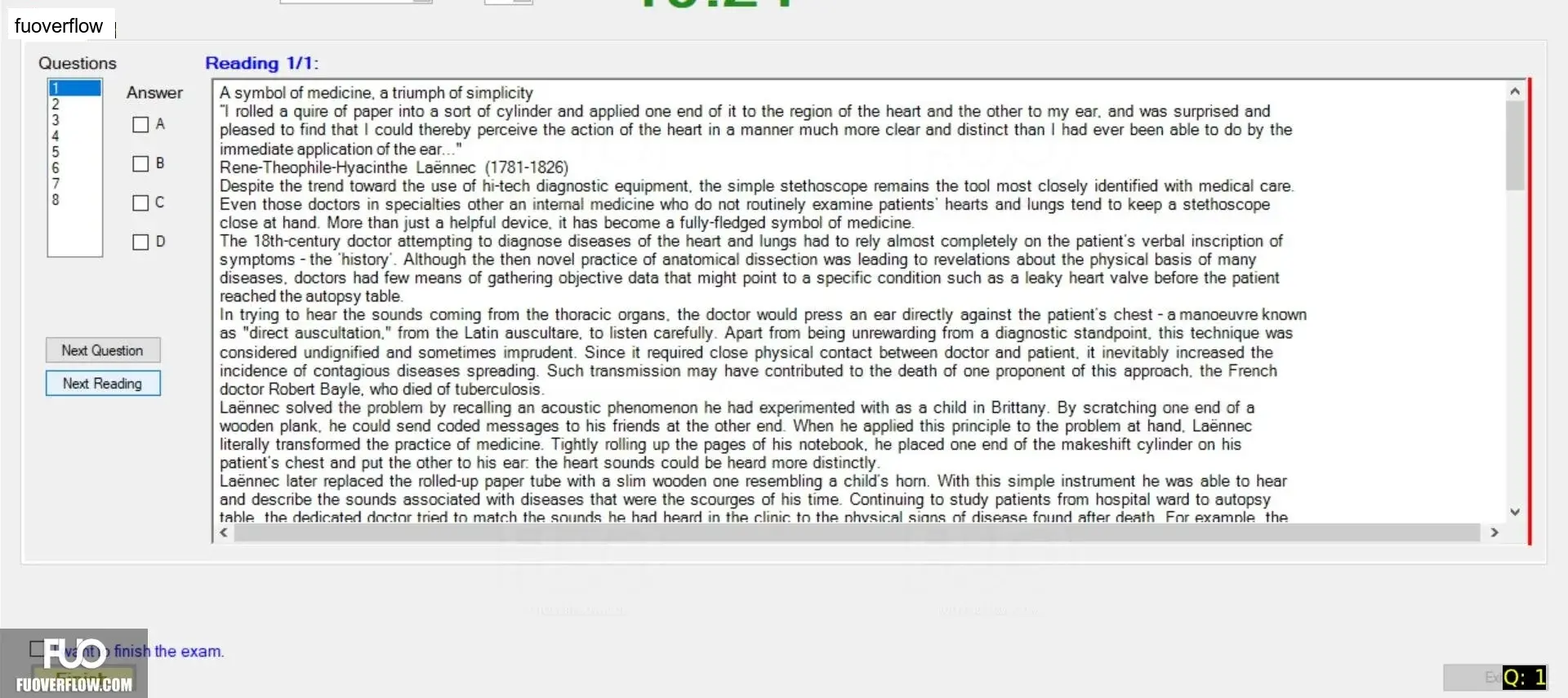
A symbol of medicine, a triumph of simplicity
"I rolled a quire of paper into a sort of cylinder and applied one end of it to the region of the heart and the other to my ear, and was surprised and pleased to find that I could thereby perceive the action of the heart in a manner much more clear and distinct than I had ever been able to do by the
immediate application of the ear..."
Rene-Theophile-Hyacinthe Laennec (1781-1826)
Despite the trend toward the use of hi-tech diagnostic equipment, the simple stethoscope remains the tool most closely identified with medical care.Even those doctors in specialties other an internal medicine who do not routinely examine patients' hearts and lungs tend to keep a stethoscope close at hand. More than just a helpful device, it has become a fully-fledged symbol of medicine.
The 18th-century doctor attempting to diagnose diseases of the heart and lungs had to rely almost completely on the patient's verbal inscription of symptoms - the 'history'. Although the then novel practice of anatomical dissection was leading to revelations about the physical basis of many diseases, doctors had few means of gathering objective data that might point to a specific condition such as a leaky heart valve before the patient reached the autopsy table.In trying to hear the sounds coming from the thoracic organs, the doctor would press an ear directly against the patient's chest - a manoeuvre known as "direct auscultation," from the Latin auscultare, to listen carefully. Apart from being unrewarding from a diagnostic standpoint, this technique was
considered undignified and sometimes imprudent. Since it required close physical contact between doctor and patient, it inevitably increased the
incidence of contagious diseases spreading. Such transmission may have contributed to the death of one proponent of this approach, the French
doctor Robert Bayle, who died of tuberculosis.
Next Reading
>
vant) fini
EQ: 1
Laennec solved the problem by recalling an acoustic phenomenon he had experimented with as a child in Brittany. By scratching one end of a wooden plank, he could send coded messages to his friends at the other end. When he applied this principle to the problem at hand, Laënnec literally transformed the practice of medicine. Tightly rolling up the pages of his notebook, he placed one end of the makeshift cylinder on his patient's chest and put the other to his ear: the heart sounds could be heard more distinctly.
Laennec later replaced the rolled-up paper tube with a slim wooden one resembling a child's horn. With this simple instrument he was able to hear and describe the sounds associated with diseases that were the scourges of his time. Continuing to study patients from hospital ward to autopsy table the dedicated doctor tried to match the sounds he had heard in the clinic to the physical signs of disease found after death For example the
<