Install the app
How to install the app on iOS
Follow along with the video below to see how to install our site as a web app on your home screen.
Note: This feature may not be available in some browsers.
-

Cùng tham gia nhóm của FuOverflow trên Facebook https://www.facebook.com/groups/nvh2fuoverflow
You are using an out of date browser. It may not display this or other websites correctly.
You should upgrade or use an alternative browser.
You should upgrade or use an alternative browser.

TRS601_-_F24P2_-_T1_-_RS2_3115.webp
Bài viết gốc: Chủ đề 'TRS601 - F24P2 - T1 - RS2'
Reading
Questions
123456789101
Next Question
Next Reading
Reading 1/1:
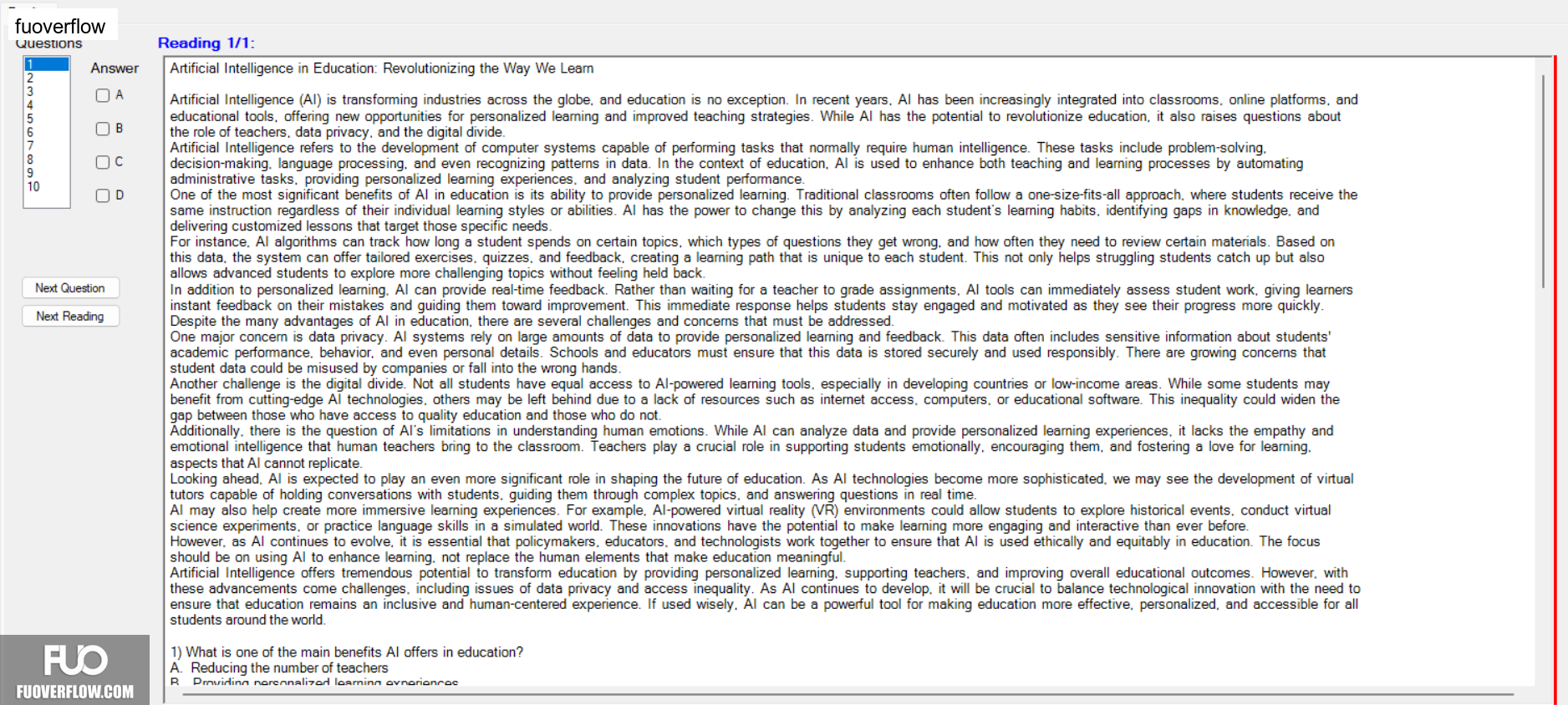
Artificial Intelligence in Education: Revolutionizing the Way We Learn
Artificial Intelligence (Al) is transforming industries across the globe, and education is no exception. In recent years. Al has been increasingly integrated into classrooms, online platforms, and educational tools, offering new opportunities for personalized learning and improved teaching strategies. While Al has the potential to revolutionize education, it also raises questions about the role of teachers, data privacy, and the digital divide.
Artificial Intelligence refers to the development of computer systems capable of performing tasks that normally require human intelligence. These tasks include problem-solving.
decision-making, language processing, and even recognizing patterns in data. In the context of education, Al is used to enhance both teaching and learning processes by automating administrative tasks, providing personalized learning experiences, and analyzing student performance.One of the most significant benefits of Al in education is its ability to provide personalized learning. Traditional classrooms often follow a one-size-fits-all approach, where students receive the
same instruction regardless of their individual learning styles or abilities. Al has the power to change this by analyzing each student's learning habits, identifying gaps in knowledge, and delivering customized lessons that target those specific needs.For instance, Al algorithms can track how long a student spends on certain topics, which types of questions they get wrong, and how often they need to review certain materials. Based on
this data, the system can offer tailored exercises, quizzes, and feedback, creating a learning path that is unique to each student. This not only helps struggling students catch up but also allows advanced students to explore more challenging topics without feeling held back.
In addition to personalized learning. Al can provide real-time feedback. Rather than waiting for a teacher to grade assignments. Al tools can immediately assess student work, giving learners instant feedback on their mistakes and guiding them toward improvement. This immediate response helps students stay engaged and motivated as they see their progress more quickly.
Despite the many advantages of Al in education, there are several challenges and concerns that must be addressed.
One major concern is data privacy. Al systems rely on large amounts of data to provide personalized learning and feedback. This data often includes sensitive information about students'academic performance, behavior, and even personal details. Schools and educators must ensure that this data is stored securely and used responsibly. There are growing concerns that
student data could be misused by companies or fall into the wrong hands.Another challenge is the digital divide. Not all students have equal access to Al-powered learning tools, especially in developing countries or low-income areas. While some students may benefit from cutting-edge Al technologies, others may be left behind due to a lack of resources such as internet access, computers, or educational software. This inequality could widen the gap between those who have access to quality education and those who do not.
Additionally, there is the question of Al's limitations in understanding human emotions. While Al can analyze data and provide personalized learning experiences, it lacks the empathy and emotional intelligence that human teachers bring to the classroom. Teachers play a crucial role in supporting students emotionally, encouraging them, and fostering a love for learning.aspects that Al cannot replicate.
Looking ahead. Al is expected to play an even more significant role in shaping the future of education. As Al technologies become more sophisticated, we may see the development of virtual tutors capable of holding conversations with students, guiding them through complex topics, and answering questions in real time.
Al may also help create more immersive learning experiences. For example, Al-powered virtual reality (VR) environments could allow students to explore historical events, conduct virtual science experiments, or practice language skills in a simulated world. These innovations have the potential to make learning more engaging and interactive than ever before.However, as Al continues to evolve, it is essential that policymakers, educators, and technologists work together to ensure that Al is used ethically and equitably in education. The focus should be on using Al to enhance learning, not replace the human elements that make education meaningful.
Artificial Intelligence offers tremendous potential to transform education by providing personalized learning, supporting teachers, and improving overall educational outcomes. However, with these advancements come challenges, including issues of data privacy and access inequality. As Al continues to develop, it will be crucial to balance technological innovation with the need to ensure that education remains an inclusive and human-centered experience. If used wisely. Al can be a powerful tool for making education more effective, personalized, and accessible for all students around the world.
1) What is one of the main benefits Al offers in education?
A. Reducing the number of teachers R Providing norennalized learninn avnariancas
Questions
123456789101
Next Question
Next Reading
Reading 1/1:
Artificial Intelligence in Education: Revolutionizing the Way We Learn
Artificial Intelligence (Al) is transforming industries across the globe, and education is no exception. In recent years. Al has been increasingly integrated into classrooms, online platforms, and educational tools, offering new opportunities for personalized learning and improved teaching strategies. While Al has the potential to revolutionize education, it also raises questions about the role of teachers, data privacy, and the digital divide.
Artificial Intelligence refers to the development of computer systems capable of performing tasks that normally require human intelligence. These tasks include problem-solving.
decision-making, language processing, and even recognizing patterns in data. In the context of education, Al is used to enhance both teaching and learning processes by automating administrative tasks, providing personalized learning experiences, and analyzing student performance.One of the most significant benefits of Al in education is its ability to provide personalized learning. Traditional classrooms often follow a one-size-fits-all approach, where students receive the
same instruction regardless of their individual learning styles or abilities. Al has the power to change this by analyzing each student's learning habits, identifying gaps in knowledge, and delivering customized lessons that target those specific needs.For instance, Al algorithms can track how long a student spends on certain topics, which types of questions they get wrong, and how often they need to review certain materials. Based on
this data, the system can offer tailored exercises, quizzes, and feedback, creating a learning path that is unique to each student. This not only helps struggling students catch up but also allows advanced students to explore more challenging topics without feeling held back.
In addition to personalized learning. Al can provide real-time feedback. Rather than waiting for a teacher to grade assignments. Al tools can immediately assess student work, giving learners instant feedback on their mistakes and guiding them toward improvement. This immediate response helps students stay engaged and motivated as they see their progress more quickly.
Despite the many advantages of Al in education, there are several challenges and concerns that must be addressed.
One major concern is data privacy. Al systems rely on large amounts of data to provide personalized learning and feedback. This data often includes sensitive information about students'academic performance, behavior, and even personal details. Schools and educators must ensure that this data is stored securely and used responsibly. There are growing concerns that
student data could be misused by companies or fall into the wrong hands.Another challenge is the digital divide. Not all students have equal access to Al-powered learning tools, especially in developing countries or low-income areas. While some students may benefit from cutting-edge Al technologies, others may be left behind due to a lack of resources such as internet access, computers, or educational software. This inequality could widen the gap between those who have access to quality education and those who do not.
Additionally, there is the question of Al's limitations in understanding human emotions. While Al can analyze data and provide personalized learning experiences, it lacks the empathy and emotional intelligence that human teachers bring to the classroom. Teachers play a crucial role in supporting students emotionally, encouraging them, and fostering a love for learning.aspects that Al cannot replicate.
Looking ahead. Al is expected to play an even more significant role in shaping the future of education. As Al technologies become more sophisticated, we may see the development of virtual tutors capable of holding conversations with students, guiding them through complex topics, and answering questions in real time.
Al may also help create more immersive learning experiences. For example, Al-powered virtual reality (VR) environments could allow students to explore historical events, conduct virtual science experiments, or practice language skills in a simulated world. These innovations have the potential to make learning more engaging and interactive than ever before.However, as Al continues to evolve, it is essential that policymakers, educators, and technologists work together to ensure that Al is used ethically and equitably in education. The focus should be on using Al to enhance learning, not replace the human elements that make education meaningful.
Artificial Intelligence offers tremendous potential to transform education by providing personalized learning, supporting teachers, and improving overall educational outcomes. However, with these advancements come challenges, including issues of data privacy and access inequality. As Al continues to develop, it will be crucial to balance technological innovation with the need to ensure that education remains an inclusive and human-centered experience. If used wisely. Al can be a powerful tool for making education more effective, personalized, and accessible for all students around the world.
1) What is one of the main benefits Al offers in education?
A. Reducing the number of teachers R Providing norennalized learninn avnariancas