Questions
12345678
Reading 2/2:
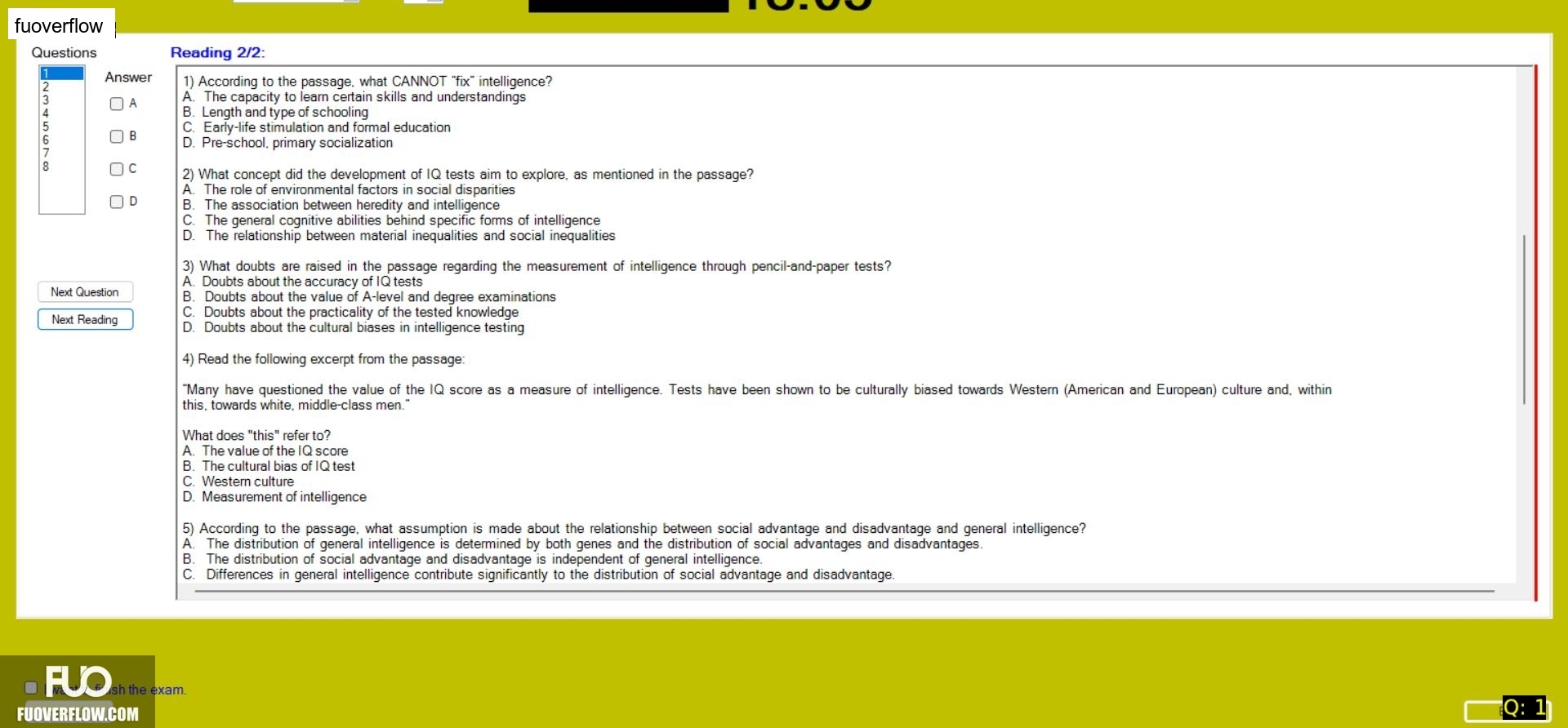
1) According to the passage, what CANNOT "fix" intelligence?
A. The capacity to learn certain skills and understandings
B. Length and type of schooling
C. Early-life stimulation and formal education
D. Pre-school, primary socialization
2) What concept did the development of IQ tests aim to explore, as mentioned in the passage?
A. The role of environmental factors in social disparities
B. The association between heredity and intelligence
C. The general cognitive abilities behind specific forms of intelligence D. The relationship between material inequalities and social inequalities
Next Question
Next Reading
3) What doubts are raised in the passage regarding the measurement of intelligence through pencil-and-paper tests?
A. Doubts about the accuracy of IQ tests
B. Doubts about the value of A-level and degree examinations C. Doubts about the practicality of the tested knowledge
D. Doubts about the cultural biases in intelligence testing
4) Read the following excerpt from the passage:
"Many have questioned the value of the IQ score as a measure of intelligence. Tests have been shown to be culturally biased towards Western (American and European) culture and, within this, towards white, middle-class men."
What does "this" refer to?
A. The value of the IQ score
B. The cultural bias of IQ test
C. Western culture
D. Measurement of intelligence
5) According to the passage, what assumption is made about the relationship between social advantage and disadvantage and general intelligence?
A. The distribution of general intelligence is determined by both genes and the distribution of social advantages and disadvantages.
B. The distribution of social advantage and disadvantage is independent of general intelligence.
C. Differences in general intelligence contribute significantly to the distribution of social advantage and disadvantage.