Questions
Reading 1/2:
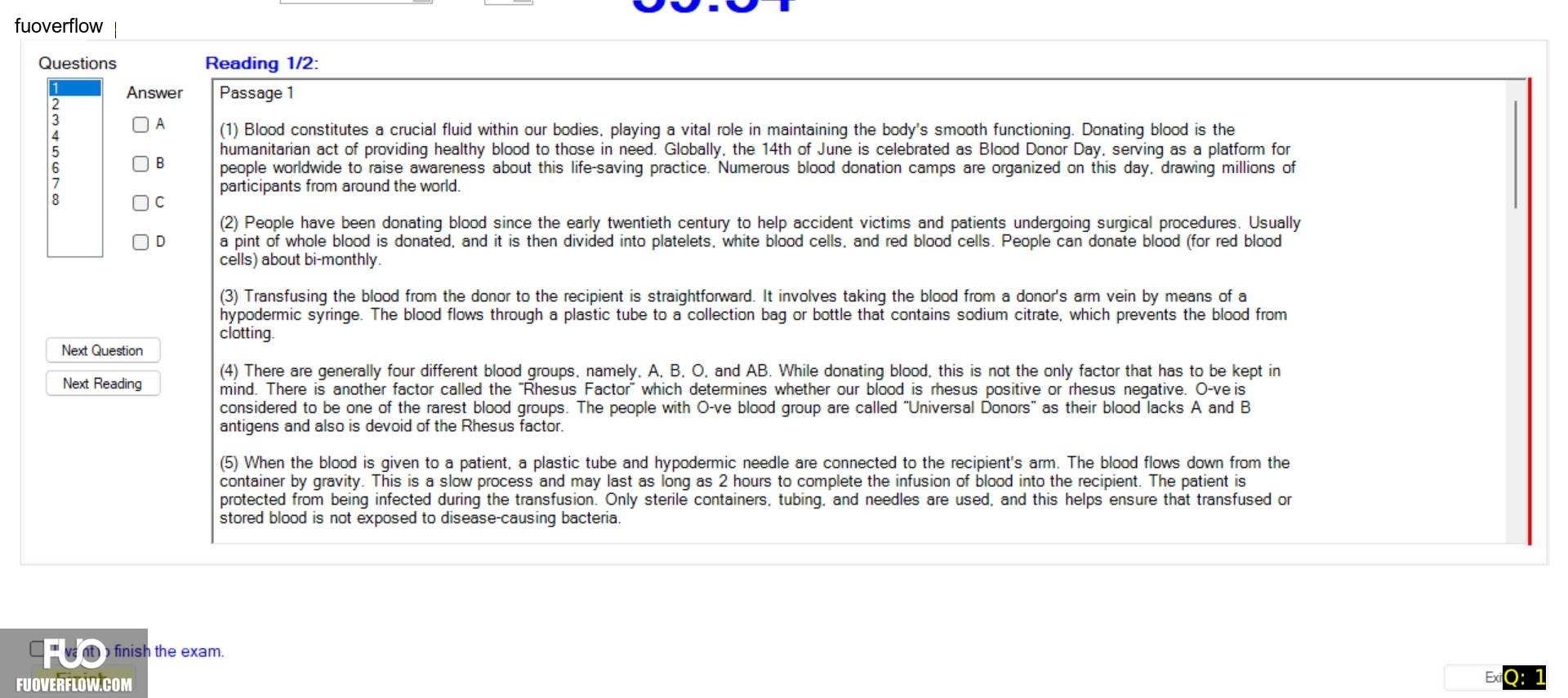
Passage 1
(1) Blood constitutes a crucial fluid within our bodies, playing a vital role in maintaining the body's smooth functioning. Donating blood is the
humanitarian act of providing healthy blood to those in need. Globally, the 14th of June is celebrated as Blood Donor Day, serving as a platform for
people worldwide to raise awareness about this life-saving practice. Numerous blood donation camps are organized on this day, drawing millions of
participants from around the world.
12345678
(2) People have been donating blood since the early twentieth century to help accident victims and patients undergoing surgical procedures. Usually a pint of whole blood is donated, and it is then divided into platelets, white blood cells, and red blood cells. People can donate blood (for red blood cells) about bi-monthly.
(3) Transfusing the blood from the donor to the recipient is straightforward. It involves taking the blood from a donor's arm vein by means of a hypodermic syringe. The blood flows through a plastic tube to a collection bag or bottle that contains sodium citrate, which prevents the blood from clotting.
Next Question
Next Reading
(4) There are generally four different blood groups, namely. A. B. O, and AB. While donating blood, this is not the only factor that has to be kept in mind. There is another factor called the "Rhesus Factor which determines whether our blood is rhesus positive or rhesus negative. O-ve is considered to be one of the rarest blood groups. The people with O-ve blood group are called "Universal Donors" as their blood lacks A and B antigens and also is devoid of the Rhesus factor.
(5) When the blood is given to a patient, a plastic tube and hypodermic needle are connected to the recipient's arm. The blood flows down from the container by gravity. This is a slow process and may last as long as 2 hours to complete the infusion of blood into the recipient. The patient is protected from being infected during the transfusion. Only sterile containers, tubing, and needles are used, and this helps ensure that transfused or stored blood is not exposed to disease-causing bacteria.
vant finish
the exam.