Reading
Questions
Reading 1/1:
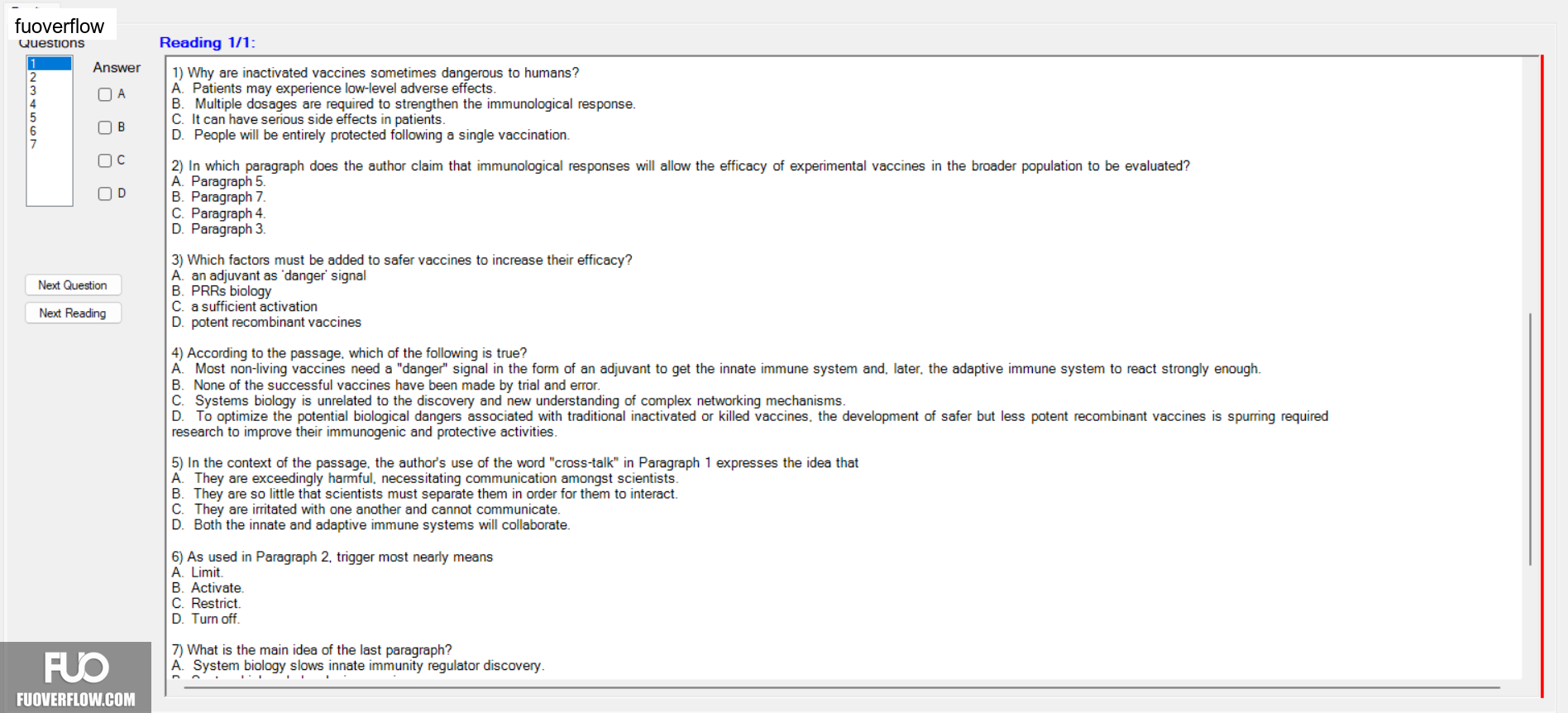
1) Why are inactivated vaccines sometimes dangerous to humans?
1234567
A. Patients may experience low-level adverse effects.
B. Multiple dosages are required to strengthen the immunological response.
C. It can have serious side effects in patients.
D. People will be entirely protected following a single vaccination.
2) In which paragraph does the author claim that immunological responses will allow the efficacy of experimental vaccines in the broader population to be evaluated?
A. Paragraph 5.
B. Paragraph 7.
C. Paragraph 4.D. Paragraph 3.
3) Which factors must be added to safer vaccines to increase their efficacy?
Next Question
A. an adjuvant as 'danger' signal
B. PRRs biology
C. a sufficient activation
Next Reading
D. potent recombinant vaccines
4) According to the passage, which of the following is true?
. Most non-living vaccines need a "danger" signal in the form of an adjuvant to get the innate immune system and, later, the adaptive immune system to react strongly enough.
A B. None of the successful vaccines have been made by trial and error.
C. Systems biology is unrelated to the discovery and new understanding of complex networking mechanisms.
D. To optimize the potential biological dangers associated with traditional inactivated or killed vaccines, the development of safer but less potent recombinant vaccines is spurring required research to improve their immunogenic and protective activities.
5) In the context of the passage, the author's use of the word "cross-talk" in Par Paragraph 1 expresses the idea that
A. They are exceedingly harmful, necessitating communication amongst scientists.. They are so little that scientists must separate them in order for them to interact.
B C. They are irritated with one another and cannot communicate.
D. Both the innate and adaptive immune systems will collaborate.
6) As used in Paragraph 2, trigger most nearly means
A. Limit.
B. Activate.
C. Restrict.
D. Turn off.
7) What is the main idea of the last paragraph?
A. System biology slows innate immunity regulator discovery.