Đề Thi PE SWE201c - FA 2024 - PE1

  • Bắt đầu Bắt đầu Kaminari76
  • Ngày bắt đầu Ngày bắt đầu
  • Trả lời Trả lời 14
  • Xem Xem 20K
  • Thẻ Thẻ
    swe201c
Campus
Hà Nội
Học kỳ
FALL2024
Loại tài liệu
FE

Kaminari76

FPT Student
Tham gia
21/7/23
Bài viết
0
FUO Point
1,158
SWE201c - FA 2024 - PE1
30/11/2024 12h50
 

Đính kèm

  • SWE201c_-_FA_2024_-_PE1_3130.webp
    SWE201c_-_FA_2024_-_PE1_3130.webp
    522.4 KB · Xem: 22,144
  • SWE201c_-_FA_2024_-_PE1_3130.webp
    SWE201c_-_FA_2024_-_PE1_3130.webp
    551 KB · Xem: 20,764
  • SWE201c_-_FA_2024_-_PE1_3130.webp
    SWE201c_-_FA_2024_-_PE1_3130.webp
    501.4 KB · Xem: 21,217
  • SWE201c_-_FA_2024_-_PE1_3130.webp
    SWE201c_-_FA_2024_-_PE1_3130.webp
    396.6 KB · Xem: 20,455
  • SWE201c_-_FA_2024_-_PE1_3130.webp
    SWE201c_-_FA_2024_-_PE1_3130.webp
    181.6 KB · Xem: 16,192
  • SWE201c_-_FA_2024_-_PE1_3130.webp
    SWE201c_-_FA_2024_-_PE1_3130.webp
    344.3 KB · Xem: 10,196
  • SWE201c_-_FA_2024_-_PE1_3130.webp
    SWE201c_-_FA_2024_-_PE1_3130.webp
    366.5 KB · Xem: 7,716
  • SWE201c_-_FA_2024_-_PE1_3130.webp
    SWE201c_-_FA_2024_-_PE1_3130.webp
    126.8 KB · Xem: 6,174
  • SWE201c_-_FA_2024_-_PE1_3130.webp
    SWE201c_-_FA_2024_-_PE1_3130.webp
    135.9 KB · Xem: 8,441
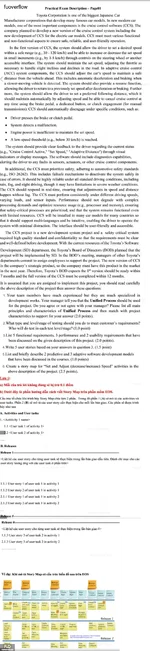
3. Requirements for the Cruise Control System:
Functional Requirements:

The system should let the driver set a speed within a safe range (e.g., 30 - 120 km/h).
The system should automatically adjust speed to maintain a safe distance from the car in front.
The driver should be able to cancel the cruise control at any time using the brake pedal or a dedicated button.
The system should provide feedback to the driver on its current status (e.g., "Cruise Control Active").
The system should disengage automatically under certain conditions (e.g., brake press or system malfunction).
Performance Requirements:

The system must respond quickly to changes in speed and distance, with no noticeable delay.
The system should perform well under different driving speeds, loads, and sensor conditions.
The system should use resources efficiently (e.g., processor and memory) while prioritizing safety-critical processes.
Usability Requirements:

The system should support multiple languages and have an easy-to-use interface.
The system should be user-friendly, allowing the driver to operate it with minimal distractions.


5. Software Development Models:
Predictive Models:

Waterfall Model: A step-by-step approach where each phase must be completed before moving on to the next. It’s best used when the project’s requirements are clear and unlikely to change.
V-Model: Similar to the Waterfall model, but places more emphasis on testing. Each phase of development is tested immediately to catch issues early.
Adaptive Models:

Agile Model: A flexible, iterative approach where requirements can change during development based on feedback from stakeholders. The team works in short cycles (iterations) to deliver small parts of the system.
Scrum: A specific Agile framework that works in short periods called sprints (usually 2-4 weeks). At the end of each sprint, the team delivers a small part of the project, and the customer gives feedback.
Lean Software Development: Focuses on delivering value to the customer by reducing waste and making small, regular improvements. It helps the team work faster and more efficiently.

Trích coursera, mở chứng chỉ ra xem đi.


Còn câu 1 thì thôi, retake đi
 
Question 1:
I agree with the manager’s suggestion to use the Unified Process (UP) for this project, given the characteristics and challenges of the Cruise Control System (CCS) project. Below are the main principles and characteristics of the Unified Process matched with the project characteristics:
Principles and Characteristics of Unified Process:
- Iterative and Incremental Development:
+ UP breaks the project into iterations, delivering incremental advance and guaranteeing continuous refinement.
+ Relevance: The CCS venture includes delivering a functional to begin with version in 7 months, taken after by the complete version in 12 months. This aligns with UP’s iterative nature.
- Use-Case Driven:
+ UP emphasizes capturing functional requirements in terms of use cases to direct development and testing.
+ Relevance: CCS has clear functional requirements like speed alteration, versatile separate maintenance, and separation criteria, which can be modeled as use cases.
- Architecture-Centric:
+ Focuses on defining and validating a robust system architecture early in the project lifecycle.
+ Relevance: CCS requires a high-quality, safety-critical architecture adhering to ISO 26262 standards.
- Risk-Driven Development:
+ High-risk elements are tackled early in the lifecycle to mitigate project risks.
+ Relevance: CCS is a safety-critical system where risks such as malfunctions or failures in adverse conditions must be addressed promptly.
- Four Phases (Inception, Elaboration, Construction, Transition):
+ Each phase addresses specific project goals: understanding requirements, building architecture, developing functionality, and deploying.
+ Relevance: The CCS project’s phased deliverables align well with these phases.
Match with CCS Extend Characteristics:
- Security and Reliability: Requires systematic risk management and strong architecture design.
- Complexity: Requests a phased approach to handle complex requirements like adaptive cruise control and failsafe components.
- Tight Timeline: The iterative approach guarantees timely delivery of the primary adaptation.
- Team Expertise: Experienced developers can benefit from UP’s structured guidance, even if they lack strong analytical skills.
 
Question 2:
Unit Testing:
- Type: Functional testing.
- Purpose: Validate individual components like speed control, throttle adjustment, and brake engagement.
- Performed By: Developers.
Integration Testing:
- Type: Functional and performance testing.
- Purpose: Ensure that components (e.g., throttle control, adaptive distance sensors, brake actuators) work together seamlessly.
- Performed By: Developers and Test Engineers.
System Testing:
- Type: Functional, performance, and usability testing.
- Purpose: Test the entire CCS for compliance with functional, safety, and performance requirements under real-world conditions.
- Performed By: Test Engineers.
Acceptance Testing:
- Type: Usability and reliability testing.
- Purpose: Validate that the CCS meets customer expectations and adheres to ISO 26262 safety standards.
- Performed By: Customer Representatives.
Question 3:
Functional Requirements:
- The system must allow the driver to set a wanted speed between 30-120 km/h.
- The system must alter the throttle to maintain the set speed on inclines and decreases.
- The system must automatically decelerate and brake to preserve a safe distance from a vehicle ahead.
- The system must provide a "continue" function to return to a previously set speed.
- The system must automatically separate when the brake pedal or clutch pedal is squeezed.
Performance Requirements:
- The CCS must respond in real-time to sensor inputs and environmental changes.
- The system must keep up performance consistency under changing loads and speeds.
- Resource usage (processor and memory) must be optimized to prioritize safety-critical processes.
Usability Requirements:
- The system must provide clear feedback to the driver through visual indicators (e.g., "Cruise Control Active").
- The interface must be instinctive and support multi-language functionality for global usage.
 
Question 5:
Predictive Models:
Waterfall Model:
- Sequential phases: requirements → design → implementation → testing → deployment.
- Description: Best suited for projects with well-defined requirements upfront. Predictable but inflexible to changes.
- Example: CCS’s safety-critical standards might benefit from the structured approach.
V-Model:
- An extension of the Waterfall Model emphasizing validation and verification at every stage.
- Description: Each development phase has a corresponding testing phase. Ensures high-quality deliverables.
- Example: Suitable for CCS to align development and testing processes with ISO 26262 standards.
Adaptive Models:
Scrum:
- Iterative and collaborative framework with sprints (2-4 weeks).
- Description: Enables frequent updates, customer feedback, and quick adaptability to changes.
- Example: Useful for developing the initial CCS version within 7 months.
Extreme Programming (XP):
- Emphasizes continuous delivery, close collaboration, and responsiveness to changing requirements.
- Description: Prioritizes real-time feedback and technical excellence.
- Example: Ideal for refining complex features like adaptive cruise control and real-time response.
Lean Development:
- Focuses on delivering value quickly while minimizing waste.
- Description: Encourages simplicity, customer focus, and adaptability.
- Example: Can help in meeting tight deadlines for CCS’s incremental versions.
 
Question 4: As a driver, I want to set a desired speed between 30-120 km/h so that I can maintain a consistent and safe speed while driving.
As a driver, I want to adjust my speed incrementally by 1-5 km/h using controls, so I can fine-tune my speed to match traffic conditions.
As a driver, I want the system to automatically reduce my car’s speed when a slower vehicle is detected, so I can maintain a safe following distance.
As a driver, I want to resume my previously set speed after braking or deceleration, so I can return to cruising without reconfiguring the system.
As a driver, I want the system to adjust the throttle automatically on inclines and declines, so my car maintains the set speed under varying road conditions.
 
Question 6:
A. Activities and User Tasks
Activity 1: Set Speed
1.1 Allow the driver to set a desired speed within the safe range (30-120 km/h).
1.2 Provide a resume function to return to a previously set speed after deceleration or braking.
Activity 2: Adjust Speed
2.1 Allow the driver to increase the set speed incrementally (e.g., by 1-5 km/h).
2.2 Allow the driver to decrease the set speed incrementally (e.g., by 1-5 km/h).
B. Releases
Release 1
Activity 1: Set Speed
1.1.1 As a driver, I want to set a desired speed between 30-120 km/h so that I can maintain a consistent speed on highways.
1.2.1 As a driver, I want to resume my previously set speed after braking, so I don’t need to reset it manually.
Activity 2: Adjust Speed
2.1.1 As a driver, I want to incrementally increase my set speed using controls, so I can make small adjustments based on traffic flow.
2.2.1 As a driver, I want to incrementally decrease my set speed using controls, so I can safely adapt to slower traffic.
Release 2
Activity 1: Set Speed
1.1.2 As a driver, I want the system to confirm the set speed visually (e.g., display on the dashboard), so I can verify my input.
1.2.2 As a driver, I want the resume function to remember my last set speed even after restarting the car, so I can avoid reconfiguring it.
Activity 2: Adjust Speed
2.1.2 As a driver, I want the system to allow larger incremental increases (e.g., 5 km/h) for faster adjustments on highways.
2.2.2 As a driver, I want the system to adjust speed smoothly during incremental decreases to ensure comfort and safety.
 
Đề này đáp án trong cái blog ta nè :)))
bữa t ghi nhầm
 
hehe
 

Đính kèm

  • SWE201c_-_FA_2024_-_PE1_3130.webp
    SWE201c_-_FA_2024_-_PE1_3130.webp
    229.3 KB · Xem: 19,339
3. Requirements for the Cruise Control System:
Functional Requirements:

The system should let the driver set a speed within a safe range (e.g., 30 - 120 km/h).
The system should automatically adjust speed to maintain a safe distance from the car in front.
The driver should be able to cancel the cruise control at any time using the brake pedal or a dedicated button.
The system should provide feedback to the driver on its current status (e.g., "Cruise Control Active").
The system should disengage automatically under certain conditions (e.g., brake press or system malfunction).
Performance Requirements:

The system must respond quickly to changes in speed and distance, with no noticeable delay.
The system should perform well under different driving speeds, loads, and sensor conditions.
The system should use resources efficiently (e.g., processor and memory) while prioritizing safety-critical processes.
Usability Requirements:

The system should support multiple languages and have an easy-to-use interface.
The system should be user-friendly, allowing the driver to operate it with minimal distractions.


5. Software Development Models:
Predictive Models:

Waterfall Model: A step-by-step approach where each phase must be completed before moving on to the next. It’s best used when the project’s requirements are clear and unlikely to change.
V-Model: Similar to the Waterfall model, but places more emphasis on testing. Each phase of development is tested immediately to catch issues early.
Adaptive Models:

Agile Model: A flexible, iterative approach where requirements can change during development based on feedback from stakeholders. The team works in short cycles (iterations) to deliver small parts of the system.
Scrum: A specific Agile framework that works in short periods called sprints (usually 2-4 weeks). At the end of each sprint, the team delivers a small part of the project, and the customer gives feedback.
Lean Software Development: Focuses on delivering value to the customer by reducing waste and making small, regular improvements. It helps the team work faster and more efficiently.

Trích coursera, mở chứng chỉ ra xem đi.


Còn câu 1 thì thôi, retake đi
ví dụ câu 1 mình k đồng ý xong chọn lại agile hoặc waterfall dc ko anh
 
Đề này đáp án trong cái blog ta nè :)))
bữa t ghi nhầm
cho em hỏi là khi làm câu 2 kiểm thử thì Regression Testing và Performance Testing là mô hình nào cũng thêm vào được hay là chỉ có một số mô hình thôi ạ ?

và trong đề này nếu em làm là scrum ở câu 1 thì có được không ạ ?
 
cho em hỏi là khi làm câu 2 kiểm thử thì Regression Testing và Performance Testing là mô hình nào cũng thêm vào được hay là chỉ có một số mô hình thôi ạ ?

và trong đề này nếu em làm là scrum ở câu 1 thì có được không ạ ?
Regression Testing và Performance Testing viết luôn, mô hình nào cũng được
 
Back
Bên trên Bottom